What It's Really Like to Work as a Flight Attendant
From the pre-dawn crew-room briefing to the last cart stowed on descent, here is how a flight attendant's duty day is actually built, hour by hour.
By Marisol Teague · Oct 06, 2026 · 12 min read
A flight attendant's day is organized around duty periods, not office hours. You report at a fixed time, work a sequence of legs that may end in another city, and sleep where the schedule puts you. Almost all new hires start on call — reserve status — and schedules and routes are assigned by seniority (U.S. Bureau of Labor Statistics, 2025).
This guide walks through a sample duty day on a domestic trip, the equipment you handle, the part of the job people quit over, and the credential steps that get you from application to the jumpseat.
Job Snapshot
| Item | What the sources say |
|---|---|
| Typical shift length | On-duty shifts per day may vary in length (U.S. Bureau of Labor Statistics, 2025); a regional carrier posting on CareerOneStop's job finder asks for willingness to work up to 14 hours per day |
| Most common schedule type | On call — almost all new flight attendants start on reserve status, with schedules and routes assigned by seniority (U.S. Bureau of Labor Statistics, 2025) |
| Hours and rest limits | A contract between the airline and the flight attendant union generally sets total daily and monthly workable hours (U.S. Bureau of Labor Statistics, 2025); FAA rules give attendants scheduled to a duty period of 14 hours or less at least 10 consecutive hours of scheduled rest, which cannot be reduced (Federal Register/FAA, 2022) |
| Nights, weekends, holidays | Schedules are variable and often include nights, weekends and holidays, with attendants away from home several nights per week (U.S. Bureau of Labor Statistics, 2025) |
| Physical setting | Aircraft cabin and galley; O*NET reports constant contact with other people and substantial time spent walking; a regional carrier posting lists handling objects up to 50 pounds and pushing or pulling a catering cart in excess of 150 pounds (CareerOneStop employer posting) |
| Minimum entry credential | An FAA certificate of demonstrated proficiency is required to serve aboard an air carrier aircraft (U.S. Code), earned by completing your employer's initial training program and passing an exam (U.S. Bureau of Labor Statistics, 2025); BLS also lists a typical entry-level education level in the Occupational Outlook Handbook — check the current entry |
| Pay structure | Commonly paid by flight hour under the union contract, plus per diem for time away from base; BLS reported a 2025 median annual pay figure — look it up in the current Occupational Outlook Handbook rather than relying on secondhand numbers |
Before the Workday Begins
If you are on a multi-day trip, the day starts in a hotel room in a city you did not choose. The crew van time is posted the night before and is non-negotiable; miss it and you are chasing the aircraft.
Before you leave the room you check the crew app on your phone for overnight changes — an aircraft swap, a re-route, a reassignment. Reserve attendants check it for a callout instead, because the airline can assign a trip on short notice.
What goes in the bag, every single time:
- Company ID and airport SIDA badge, plus a valid passport (BLS lists a valid passport among the applicant requirements, 2025)
- Uniform to the appearance standard, including approved flat shoes for the cabin and a separate pair for boarding
- Company-issued tablet or phone holding the flight attendant manual, the safety and emergency procedures guide, and the onboard sales app
- Flashlight with charged batteries, which is a required personal item at most carriers
- Enough food for a day when catering runs out and the layover is 40 minutes
At the airport you clear crew screening, walk to the gate, and sign in. Nothing counts as duty until you report at the time your contract specifies, which is why crews watch the clock closely at sign-in.
Hour by Hour Through the Shift
A sample domestic day with three legs, starting from a layover hotel. Times shift with your report time, but the sequence rarely does.
- 5:10 a.m. — Crew van to the airport. The captain counts heads; the van leaves on time with or without the missing person.
- 5:45 a.m. — Clear crew security screening, badge through the door, walk to the gate.
- 6:05 a.m. — Preflight briefing with the lead flight attendant: emergency equipment questions, flight time, any passengers needing wheelchair or unaccompanied-minor handling.
- 6:15 a.m. — Onboard preflight safety check. You confirm the Halon fire extinguisher pressure gauge is in the green, the protective breathing equipment seal is intact, the portable oxygen bottle reads full, the AED and emergency medical kit are sealed, and the slide arming indicator is correct at your door.
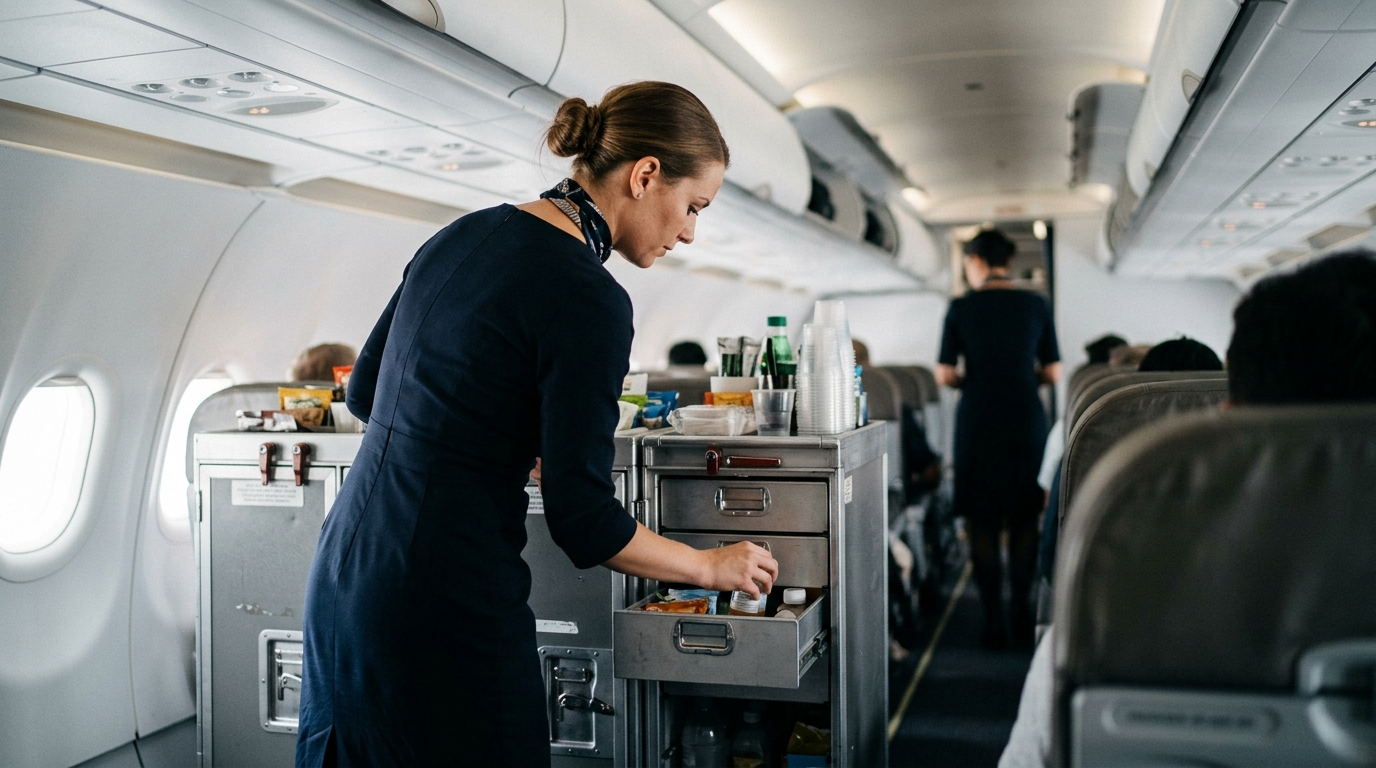
- 6:30 a.m. — Catering and galley setup: check the cart seals, count liquor and snack inventory, start the coffee, stow the carts and brake them.
- 6:40 a.m. — Boarding. You greet, check boarding passes, help with bags that do not fit, and direct exit-row seating.
- 7:02 a.m. — What goes wrong: boarding stops. The lavatory is placarded inoperative, or a gate agent brings a passenger whose carry-on will not fit and the bins are full, or a connecting crew member is late. You make the PA, re-seat people around a broken seat, and hand the cabin back to the captain for a delayed pushback.
- 7:25 a.m. — Door closed, arming doors and cross-checking, safety demonstration or video, compliance walk to check seatbelts, tray tables and stowed bags.
- 7:55 a.m. — Cruise. Cart service down a single aisle: drinks, snacks, card payments on the handheld reader, trash collection on the way back.
- 9:10 a.m. — Descent, cabin secure, final walk-through, jumpseat, landing.
- 9:40 a.m. — Deplane, quick cabin check for left items and security sweep, then boarding the next load roughly 25 minutes later. Lunch happens standing in the galley between legs, if at all.
- 1:15 p.m. and 5:40 p.m. — Legs two and three repeat the same cycle with different passengers and the same carts.
- 8:15 p.m. — Final deplane, debrief any incidents, file reports for a passenger medical event or an inoperative item.
- 8:45 p.m. — Hotel check-in. FAA rules give at least 10 consecutive hours of scheduled rest after a duty period of 14 hours or less, and that rest cannot be reduced (Federal Register/FAA, 2022).
Tools, Equipment, and Software Used Daily
- Halon fire extinguisher and protective breathing equipment (PBE)
- Portable oxygen bottle with mask, plus drop-down passenger oxygen system checks
- Automated external defibrillator (AED), enhanced emergency medical kit and first aid kit
- Evacuation slide or slide/raft, door arming and disarming levers, emergency exit handles
- Flashlight, megaphone, and restraint devices carried onboard
- Demonstration kit: seatbelt, oxygen mask, life vest
- Cabin interphone and PA handset for crew-to-crew and passenger announcements
- Galley carts, beverage carts, ovens, coffee makers and liquor kits with numbered seals
- Company-issued tablet or phone holding the flight attendant manual and onboard retail or point-of-sale app for card payments
- Crew scheduling and bidding software, plus calendar and scheduling software (O*NET lists named calendar and scheduling products used in this occupation)
- Jumpseat harness and aircraft-specific emergency equipment layouts, which change with each aircraft type you are certified on
The Toughest Part of the Job
The hardest part is not the carts or the passengers. It is reserve.
Almost all new flight attendants start out on call, and usually live near their home airport so they can report on short notice; schedule and route assignments are based on seniority (U.S. Bureau of Labor Statistics, 2025). In practice that means sitting at home with a packed bag on a day you are not flying, phone volume at maximum, unable to leave the area or have a drink. The call comes at 5:40 a.m. on a Thanksgiving you had marked off, and you are at the airport by 7:30 a.m. for a four-day trip. Schedules are variable and often include nights, weekends and holidays because airlines operate every day, and attendants may be away from home several nights per week (U.S. Bureau of Labor Statistics, 2025).
Two other recurring strains sit underneath it. O*NET reports flight attendants deal with unpleasant, angry or discourteous people — usually over bin space, delays or alcohol service — and rates the consequence of error in this occupation as extremely serious, so you are managing a rude passenger while still responsible for an armed door. BLS also reports flight attendants have one of the highest rates of injuries and illnesses of all occupations, with sprains, strains and bruises among the common injuries (2025); carts and turbulence are the usual causes.
Signs This Job Fits Your Personality
- You do not mind being interrupted mid-task, because call bells land in the middle of a cart service
- You can keep a packed bag by the door and answer the phone within minutes on a day off
- You stay flat-voiced when someone is shouting at you about a bin or a delay (O*NET reports flight attendants deal with unpleasant, angry or discourteous people)
- You are comfortable being around people for an entire shift with no private workspace (O*NET reports constant contact with other people)
- You can be on your feet and walking for most of a duty period without needing to sit down
- You can run a memorized procedure under pressure without improvising, since the consequence of error is rated extremely serious by O*NET
- You are willing to work nights, weekends and holidays and sleep away from home several nights a week (U.S. Bureau of Labor Statistics, 2025)
- You can take direction from seniority rules that decide your schedule for you for several years
How to Break Into This Career
- Confirm you meet the baseline requirements before applying (a week). BLS lists minimum age requirements, typically 18 or 21; a valid passport; a background check and drug test; vision correctable to at least 20/40; and height requirements set by many airlines (2025). Age and height specifics vary by airline — read the posting.
- Get 1 to 2 years of service-occupation experience (1–2 years). BLS reports flight attendants typically need one or two years of work experience in a service occupation, such as customer service roles in restaurants, hotels or resorts, before their first flight-attendant job (2025).
- Apply through airline careers portals and public job-finder channels (ongoing). Carrier career sites post openings directly, and flight attendant roles also appear on CareerOneStop's job finder, run by the U.S. Department of Labor. Regional carriers and mainline carriers hire on separate cycles.
- Work through the airline's hiring process (weeks to months). Expect video or recorded interviews, an in-person event, and a conditional offer subject to the background check and drug test listed by BLS.
- Complete initial training (several weeks to a few months). Airlines provide the training, usually at the airline's flight training center, and it is required for FAA certification; students go on practice flights toward the end (U.S. Bureau of Labor Statistics, 2025). PSA Airlines, a regional carrier, describes its initial program as four weeks, paid, in Charlotte, North Carolina, with hotel accommodations included; a regional carrier posting listed on CareerOneStop specifies 32 days of paid ground school in Charlotte.
- Pass the exam and get certified (end of training). All flight attendants must be certified by the FAA by completing the employer's initial training program and passing an exam, and no person may serve aboard an air carrier aircraft without a certificate of demonstrated proficiency from the FAA Administrator (BLS 2025; U.S. Code).
- Start on reserve and keep up recurrent training (year one onward). You are certified for specific aircraft types, must take new training for each additional type, and must complete recurrent training every year (U.S. Bureau of Labor Statistics, 2025). Plan to live within reporting distance of your assigned base.
Frequently asked questions
How long does reserve last before I get a regular schedule?
There is no fixed answer, because schedule and route assignments are based on seniority (U.S. Bureau of Labor Statistics, 2025). At a fast-growing carrier a new hire may hold a line within months; at a carrier with low turnover it can take years. Ask current attendants at the specific airline how long their most junior people have been on reserve.
Can the airline cut my rest if the day runs long?
No, within the rule's terms. FAA regulations require flight attendants scheduled to a duty period of 14 hours or less to be given a scheduled rest period of at least 10 consecutive hours, and that rest cannot be reduced under any circumstances (Federal Register/FAA, 2022). Longer duty periods have their own rest requirements, so check the current regulation and your contract.
Do I have to retrain if I move to a different aircraft?
Yes. Flight attendants are certified for specific aircraft types and must take new training for each type they work, in addition to recurrent training every year (U.S. Bureau of Labor Statistics, 2025). The emergency equipment locations, door operation and evacuation procedures differ enough between types that the certification does not transfer.
How is the pay actually calculated?
Most carriers pay by flight hour rather than by the full duty day, with a per diem for time away from base, and the airline–union contract generally determines total daily and monthly workable hours (U.S. Bureau of Labor Statistics, 2025). That is why a 13-hour duty day with long sits can pay less than it feels. BLS reported a 2025 median annual pay figure for the occupation — check the current Occupational Outlook Handbook entry for the number.
Is it realistic to commute to a base in another city?
Many attendants do it, but BLS notes that attendants on reserve usually live near their home airport so they can report on short notice (2025). Commuting means paying for a crash pad or hotel near base and flying standby on days off, with no guarantee of a seat. Most people only make it work after they are off reserve.
Sources
- U.S. Bureau of Labor Statistics — Flight Attendants : Occupational Outlook Handbook (2025)
- U.S. Code (via uscode.house.gov) — 49 USC 44728: Flight attendant certification

Written by
Marisol Teague
Marisol oversees how Preferred Careers thinks about work itself — not just how to get a job, but why certain ones feel worth keeping. She's drawn to the quiet negotiations people make between ambition and sanity, and edits with an eye for the sentence that gives the game away.