Inside a Typical Day as a Dental Hygienist
From the 7:15 a.m. waterline flush to the last sterilizer cycle, here is how a hygienist's operatory day actually runs — and what happens when it slips.
By Priya Nandakumar · Oct 06, 2026 · 12 min read
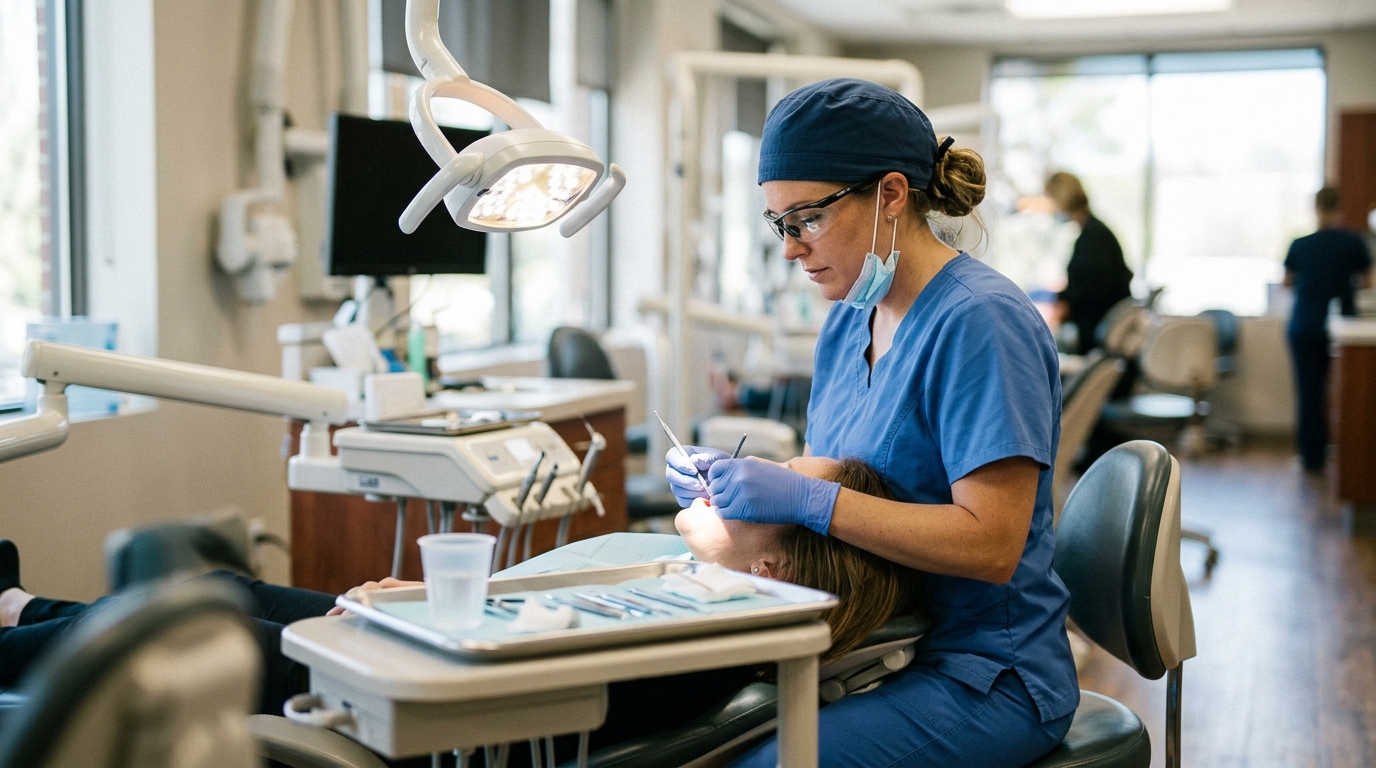
A dental hygienist's day is built around back-to-back appointment slots in a single operatory: scaling, probing, x-rays, chart notes, room turnover, repeat. Most of the work happens seated, within arm's reach of a patient's face, with gloved hands on an instrument almost continuously.
This guide walks through one clinical day in an office of dentists — the setting where most of the roughly 225,300 dental hygienist jobs were held in 2025 (U.S. Bureau of Labor Statistics, 2025) — from pre-shift setup to the last autoclave cycle, plus the tools involved and the route into licensure.
Job Snapshot
| Item | Detail (with source) |
|---|---|
| Typical shift length | Commonly a full clinical day of patient appointments, but hours vary by practice — many dental hygienists work part time, and dentists may hire a hygienist for only a few days a week (U.S. Bureau of Labor Statistics, undated) |
| Most common schedule type | Fixed, pre-booked appointment schedule rather than rotating or on-call; because some dentists hire hygienists for only a few days a week, some hygienists work for more than one dentist (U.S. Bureau of Labor Statistics, undated) |
| Physical setting | Indoor clinical operatory; dental hygienists held about 225,300 jobs in 2025, mostly in offices of dentists (U.S. Bureau of Labor Statistics, 2025) |
| Minimum entry credential | An associate's degree in dental hygiene is the typical entry-level education, and programs usually take 3 years (U.S. Bureau of Labor Statistics, undated); every state requires licensure (U.S. Bureau of Labor Statistics, undated) |
| Pay structure | Paid hourly or per clinical day in most private practices; the median annual wage was $98,100 and the median hourly wage $47.16 (U.S. Bureau of Labor Statistics, May 2025) — check the BLS Occupational Outlook Handbook and current local job postings for rates where you live |
| Required daily protection | Safety glasses, surgical masks and gloves, plus radiation-protection procedures when taking x-rays (U.S. Bureau of Labor Statistics, undated) |
Before the Workday Begins
Most hygienists arrive 30 to 45 minutes before the first appointment, because the operatory has to be ready before a patient can sit in it.
At 7:15 a.m. you change into scrubs, turn on the compressor and vacuum, and flush the dental unit waterlines so the lines are clear before the first ultrasonic scaler is run. You check the autoclave — whether yesterday's final load was processed, whether the biological indicator test is logged — and lay out wrapped instrument cassettes, prophy angles, fluoride varnish and barrier film for the first two patients.
By 7:30 a.m. you open the day's schedule in the practice management software (Dentrix, Open Dental or Patterson EagleSoft are common examples listed by O*NET OnLine, U.S. Dept. of Labor, undated) and read ahead: who is due for bitewings, who is on periodontal maintenance intervals, who has a medical alert flag such as a blood thinner, a prosthetic joint or a latex allergy. You confirm the digital x-ray sensor is connected and the lead apron and thyroid collar are hanging in the room.
If you cover more than one office — a common arrangement, since dentists may hire a hygienist for only a few days a week (U.S. Bureau of Labor Statistics, undated) — add commute time between practices and the fact that each office stocks different instruments and runs a different software system.
Hour by Hour Through the Shift
- 7:15 a.m. — Arrive, flush waterlines, start the compressor and vacuum, check the sterilizer log, set out cassettes.
- 7:40 a.m. — Morning huddle with the dentist and front desk: who is new, who is overdue for radiographs, which slots have double-booked exam checks.
- 8:00 a.m. — First patient. Update medical history, take blood pressure, complete the extraoral and intraoral soft-tissue check, then four bitewing images with the lead apron and thyroid collar in place while you step behind the barrier.
- 8:20 a.m. — Ultrasonic scaling, then hand scaling quadrant by quadrant to remove tartar, stains and plaque; polish, floss and apply fluoride varnish (tasks listed by the U.S. Bureau of Labor Statistics, undated).
- 8:45 a.m. — Report findings to the dentist, who comes in for the exam check while you chart the periodontal readings and set the recall interval.
- 8:55 a.m. — Room turnover: instruments to the ultrasonic cleaner and autoclave, surfaces wiped, barriers replaced, new tray set.
- 9:10 a.m. — Periodontal maintenance patient. Full-mouth probing, six sites per tooth, called out and entered tooth by tooth.
- 10:20 a.m. — What regularly goes wrong: the 10:15 patient arrives 18 minutes late, and the dentist is mid-extraction in the next room, so your exam check does not happen on time. You compress the appointment — scale and polish, skip the full photo series, flag the unfinished quadrant in the chart — and the delay follows you until lunch.
- 11:00 a.m. — Pediatric patient: sealant placement on newly erupted molars, plus brushing and flossing instruction with the parent in the room.
- 11:45 a.m. — Adult prophylaxis; a bitewing is retaken because the sensor shifted and clipped the distal of the second molar.
- 12:30 p.m. — Lunch, usually 30 to 45 minutes, often spent finishing chart notes, returning a periodontal referral call, or sharpening curettes.
- 1:15 p.m. — Afternoon block begins; a new-patient appointment needs a full series of radiographs and a complete periodontal charting, which fills the whole slot.
- 2:30 p.m. — The dentist asks for a periapical image on an emergency patient squeezed into the schedule, which pushes your 2:30 patient back.
- 3:30 p.m. — Heavy calculus case. Ultrasonic first, then hand instrumentation; this is the appointment that routinely runs over.
- 4:30 p.m. — Last patient. If they no-show, the time goes to sterilization, restocking fluoride and prophy paste, and clearing unsigned chart notes.
- 5:15 p.m. — Final autoclave load, evacuation line cleaner run through the suction, operatory wiped down, software closed out.
Tools, Equipment, and Software Used Daily
- Hand scalers and Gracey curettes, with a sharpening stone kept chairside
- Ultrasonic scaler (magnetostrictive or piezo inserts)
- Air-polishing device that sprays air, water and baking soda to remove stains (U.S. Bureau of Labor Statistics, undated)
- Slow-speed handpiece with disposable prophy angles for polishing
- Dental lasers, used in some practices (U.S. Bureau of Labor Statistics, undated)
- Periodontal probe, explorer, mouth mirror and cotton pliers
- Intraoral x-ray machine with digital sensors or phosphor plates, plus lead apron and thyroid collar
- Panoramic x-ray unit in offices that have one
- Intraoral camera for documenting cracks, restorations and tissue changes
- Saliva ejector and high-volume evacuation
- Autoclave and ultrasonic instrument cleaner, with biological indicator testing
- Safety glasses, surgical masks and gloves, worn every appointment (U.S. Bureau of Labor Statistics, undated)
- Magnification loupes with a headlight
- Blood pressure cuff for pre-appointment vitals
- Fluoride varnish, sealant materials, and local anesthetic or topical agents where state scope allows
- Dental office management software such as Henry Schein Dentrix, Open Dental, or Patterson Dental Supply's Patterson EagleSoft (O*NET OnLine, U.S. Dept. of Labor, undated)
- Digital imaging software linked to the sensor for capturing and storing radiographs
The Toughest Part of the Job
The recurring problem is sustained hand instrumentation in a fixed posture. Dental hygienists use their hands to handle, control or feel objects, tools or controls continually or almost continually — 100% of every workday (ONET OnLine, U.S. Dept. of Labor, undated) — and 64% say repeating the same tasks is extremely important to the job (ONET OnLine, undated).
Here is where it shows up. By the 3:30 p.m. heavy-calculus appointment, you have already hand-scaled four or five mouths, held a mirror in a retracted position with your non-dominant hand for hours, and leaned slightly forward over a reclined patient all day. The lower-left lingual surfaces require wrist rotation at an awkward angle, the patient cannot open wide, and you have 20 minutes left in the slot. That combination — repetition, pinch grip, neck flexion and time pressure — is what produces the wrist, shoulder and neck complaints hygienists talk about.
The second strain is close contact. 84% of hygienists report working in very close physical proximity to others, near touching (ONET OnLine, undated), and 97% report exposure to disease or infections every day (ONET OnLine, undated), which is why safety glasses, masks and gloves are worn for every appointment (U.S. Bureau of Labor Statistics, undated). Hygienists manage both by rotating instrument grips, using the ultrasonic scaler to reduce hand work, adjusting the chair and their own stool for each patient, and taking the full turnover gap between appointments instead of eating into it.
Signs This Job Fits Your Personality
- You are comfortable working with your hands inches from someone's face for most of the day, 84% of hygienists report that kind of proximity (O*NET OnLine, U.S. Dept. of Labor, undated)
- You can repeat the same clinical sequence a dozen times a day without losing accuracy on the twelfth
- You can keep talking a nervous patient through a procedure while your hands keep working
- You do not mind being interrupted when the dentist needs an x-ray for an emergency patient mid-appointment
- You finish chart notes the same day rather than letting them stack up until closing
- You notice a shifted sensor or a missed interproximal surface and retake or re-scale rather than move on
- You are willing to wear glasses, a mask and gloves for every single appointment, with no exceptions
- You can handle a schedule that runs 20 minutes behind by lunch and still end the day on time
How to Break Into This Career
- Complete the prerequisite coursework — usually anatomy, physiology, chemistry and microbiology, typically one to two semesters at a community college, before most dental hygiene programs will consider your application.
- Apply to a program accredited by the Commission on Dental Accreditation (CODA), the only accrediting agency for dental and allied dental education programs recognized by the U.S. Department of Education (Commission on Dental Accreditation, American Dental Association, undated). Apply directly through the program's own admissions channel; seats are limited and cycles usually open a year ahead.
- Finish the associate's degree in dental hygiene. This is the typical entry-level education, and programs usually take 3 years to complete (U.S. Bureau of Labor Statistics, undated), including supervised clinical rotations where you treat patients in the school clinic.
- Obtain CPR certification during the program — many dental hygienist jobs require it (U.S. Bureau of Labor Statistics, undated), and it is usually a one-day course you renew on the schedule your certifying body sets.
- Sit the National Board Dental Hygiene Examination (NBDHE) — a 9-hour exam offered year-round at Pearson VUE test centers in the U.S. and Canada and recognized by all U.S. licensing jurisdictions (Joint Commission on National Dental Examinations, American Dental Association, undated). Most candidates test near the end of their program.
- Pass the clinical examination your state board accepts and apply for your license. Every state requires licensure, and in most states that means an accredited degree plus written and clinical examinations (U.S. Bureau of Talent — correction: U.S. Bureau of Labor Statistics, undated). The NBDHE is intended to fulfill or partially fulfill the written requirement, but candidates should check each state board for specific requirements (Joint Commission on National Dental Examinations, undated).
- Apply to offices of dentists first, where most of the roughly 225,300 jobs were held in 2025 (U.S. Bureau of Labor Statistics, 2025). Many new hygienists start with one or two clinical days a week at a practice, or take temporary placements through dental staffing agencies, then build toward a full week. About 15,000 openings per year are projected from 2025 to 2035 (U.S. Bureau of Labor Statistics, 2025).
- Keep the license current with continuing education, which is required to maintain licensure (U.S. Bureau of Labor Statistics, undated); hours and renewal cycles are set by each state board.
Frequently asked questions
Do most dental hygienists work a standard five-day week?
Not necessarily. Many dental hygienists work part time, and dentists may hire a hygienist for only a few days a week, so some hygienists work for more than one dentist (U.S. Bureau of Labor Statistics, undated). In practice that can mean Monday and Tuesday at one office and Thursday and Friday at another, with two different software systems and instrument setups to learn.
How much patient conversation is actually involved?
A great deal — 97% of dental hygienists report face-to-face discussions with individuals and teams every day (O*NET OnLine, U.S. Dept. of Labor, undated). Beyond the clinical work, you educate patients on oral hygiene techniques and report your findings to the dentist (U.S. Bureau of Labor Statistics, undated), which means explaining probing depths, bleeding points and home care in terms a patient will follow.
Is the field growing?
Employment of dental hygienists is projected to grow 8 percent from 2025 to 2035, with about 15,000 openings projected each year (U.S. Bureau of Labor Statistics, 2025). Openings come from both growth and from hygienists leaving the occupation or retiring. Local demand still varies by state and by how many accredited programs feed your area.
Does my license transfer if I move to another state?
Every state requires dental hygienists to be licensed, and requirements differ (U.S. Bureau of Labor Statistics, undated). The NBDHE is recognized by all U.S. licensing jurisdictions and is intended to fulfill or partially fulfill the written examination requirement, but candidates are told to check each state board for specific requirements (Joint Commission on National Dental Examinations, American Dental Association, undated). Contact the board in the state you are moving to before you accept a job there.
How exact does the work have to be?
59% of dental hygienists say being exact or accurate is extremely important to the job (O*NET OnLine, U.S. Dept. of Labor, undated). That applies to periodontal probing depths recorded six sites per tooth, radiograph angulation that avoids clipping a contact, and chart documentation of care and treatment plans (U.S. Bureau of Labor Statistics, undated), which the dentist and the next hygienist both rely on.
Sources
- U.S. Bureau of Labor Statistics — Dental Hygienists : Occupational Outlook Handbook (2025-05)
- O*NET OnLine (U.S. Dept. of Labor) — 29-1292.00 - Dental Hygienists

Written by
Priya Nandakumar
Priya covers the texture of offices, remote teams, and the spaces in between — what makes a workplace bearable or unbearable long after the paycheck stops mattering. She likes stories where nobody is the villain.