What Does a Physical Therapist Assistant Actually Do All Day?
From the 7:45 a.m. gait-training session to the last progress note of the shift, here is how the hours, patient contact and lifting actually stack up.
By Priya Nandakumar · Oct 06, 2026 · 5 min read
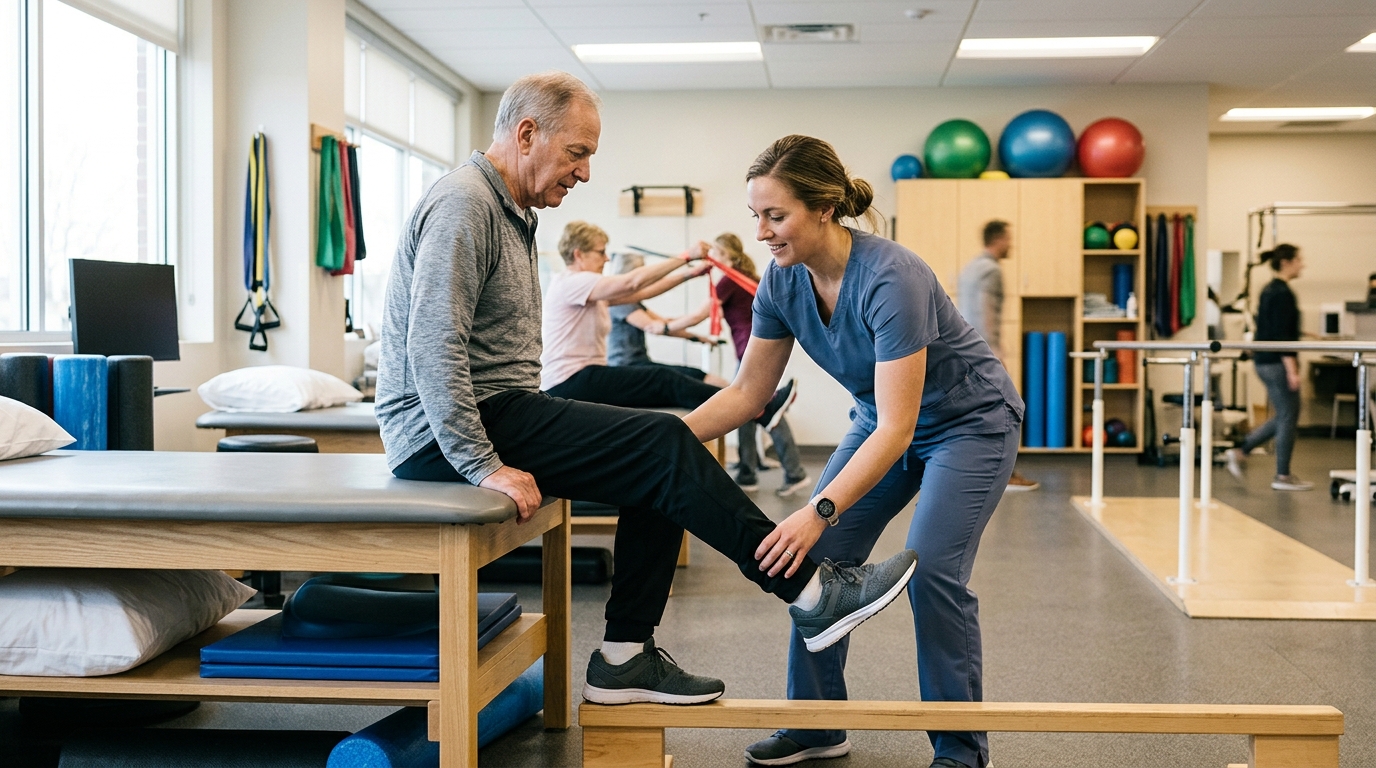
Physical therapist assistants carry out treatment plans written by a supervising physical therapist: guiding patients through assigned exercises, using techniques such as massage and stretching, and helping people use devices like walkers (U.S. Bureau of Labor Statistics, 2025). After each visit, you record the patient's progress and report the results of the treatment back to the therapist (U.S. Bureau of Labor Statistics, 2025).
Hours and setting vary a lot — a hospital rehab floor, an outpatient clinic with evening slots and a skilled nursing facility run on different schedules, and licensure rules are set state by state.
At a Glance
| Item | What the sources say |
|---|---|
| Typical hours | Most physical therapist assistants work full time, though part-time work is common; some work nights and weekends because many clinics keep extended hours to fit patients' schedules (U.S. Bureau of Labor Statistics, 2025). |
| Work setting | Mostly physical therapists' offices or hospitals, with the largest employer category being offices of physical, occupational and speech therapists, and audiologists (U.S. Bureau of Labor Statistics, 2025). |
| Physical demand | High: 72% of surveyed respondents report standing more than half the time (O*NET OnLine), and lifting and moving patients leaves assistants vulnerable to back injuries (U.S. Bureau of Labor Statistics, 2025). |
| Closeness to people | 97% of respondents report constant contact with others and 97% report working at very close physical proximity, near touching (O*NET OnLine). |
| Entry requirement | An associate's degree from an accredited physical therapist assistant program, typically about 2 years including anatomy, physiology and kinesiology, plus state licensure or certification requiring a qualifying exam — required in all states (U.S. Bureau of Labor Statistics, 2025). |
| Preparation level | Job Zone Three: Medium Preparation Needed (O*NET OnLine). |
What a Typical Day Looks Like
At 7:30 a.m. you unlock the treatment gym, wipe down the mat tables and read the supervising therapists' plans of care for everyone on your schedule. Your first patient arrives at 7:45 a.m. for gait training: you fit the gait belt, set the walker to the right height and walk beside them for twenty minutes, counting steps and watching for loss of balance. At 8:30 a.m. you take a post-surgical knee patient through the exercises the therapist assigned, finishing with soft-tissue massage and hamstring stretching. Between patients you type a note into the clinic's electronic record describing what the patient managed and what changed — swelling, pain reports, a rep they could not finish. At 11:00 a.m. you spend ten minutes teaching a patient's daughter how to guard him on stairs at home. You eat at 12:30 p.m., sometimes in fifteen minutes because a 12:45 p.m. evaluation ran long. From 1:30 p.m. the pattern repeats: securing patients onto therapy equipment, setting resistance, cueing form out loud, cleaning between uses. At 4:00 p.m. you catch the supervising physical therapist for five minutes to report that one patient's shoulder range has not improved, so the plan can be changed. From 5:15 p.m. you finish outstanding notes and leave around 5:45 p.m. — later if your clinic runs evening appointments for patients who work days.
Daily Tasks You'll Actually Do
- Fit a gait belt, adjust a walker or crutches to height, and walk a patient the length of the hallway while guarding them.
- Secure a patient onto therapy equipment such as a bike or traction table before the session starts (O*NET OnLine task list).
- Count reps and correct form out loud while a patient practises the exercises written into the plan of care.
- Apply massage and stretching to a stiff joint at the end of a treatment session.
- Type a progress note after each visit and flag anything that changed for the supervising physical therapist.
- Spend ten minutes showing a spouse or adult child how to help with the home exercise program before discharge.
- Wipe down mats and equipment and restock linens and resistance bands between appointments.
- Report verbally to the supervising therapist when a patient's response does not match the plan.
Quick Fit Check
- Can you stay on your feet for more than half of a shift, sitting only to type notes? (72% of respondents report standing more than half the time — O*NET OnLine.)
- Are you comfortable working within arm's reach of strangers, often touching them, for most of the day?
- Can you physically support and move an adult who is unsteady, and would you follow safe lifting habits to protect your back?
- Are you willing to talk almost continuously — cueing, counting, explaining — rather than working quietly alone?
- Will you write a note after every single patient, not at the end of the week?
- Can you accept that someone else writes the treatment plan and you carry it out and report back?
Frequently asked questions
Do physical therapist assistants decide what treatment a patient gets?
No — assistants work under the direction and supervision of physical therapists, carrying out the plan of care and reporting the results of each treatment back (U.S. Bureau of Labor Statistics, 2025). Observing the patient before, during and after therapy and passing that information on is part of the job itself.
Are there certifications beyond the state license?
Many physical therapist assistants also hold CPR, basic life support (BLS) or other first-aid certifications (U.S. Bureau of Labor Statistics, 2025). Whether an employer requires them varies, so check the specific job posting and your state licensing board.
Sources
- U.S. Bureau of Labor Statistics — Physical Therapist Assistants and Aides : Occupational Outlook Handbook (2025)
- O*NET OnLine — 31-2021.00 - Physical Therapist Assistants

Written by
Priya Nandakumar
Priya covers the texture of offices, remote teams, and the spaces in between — what makes a workplace bearable or unbearable long after the paycheck stops mattering. She likes stories where nobody is the villain.