A Day in the Life of an EMT
What a twelve-hour ambulance shift actually contains: rig checks, back-to-back calls, restocking, charting, and the late call that delays going home.
By Desmond Okafor-Hale · Oct 06, 2026 · 11 min read
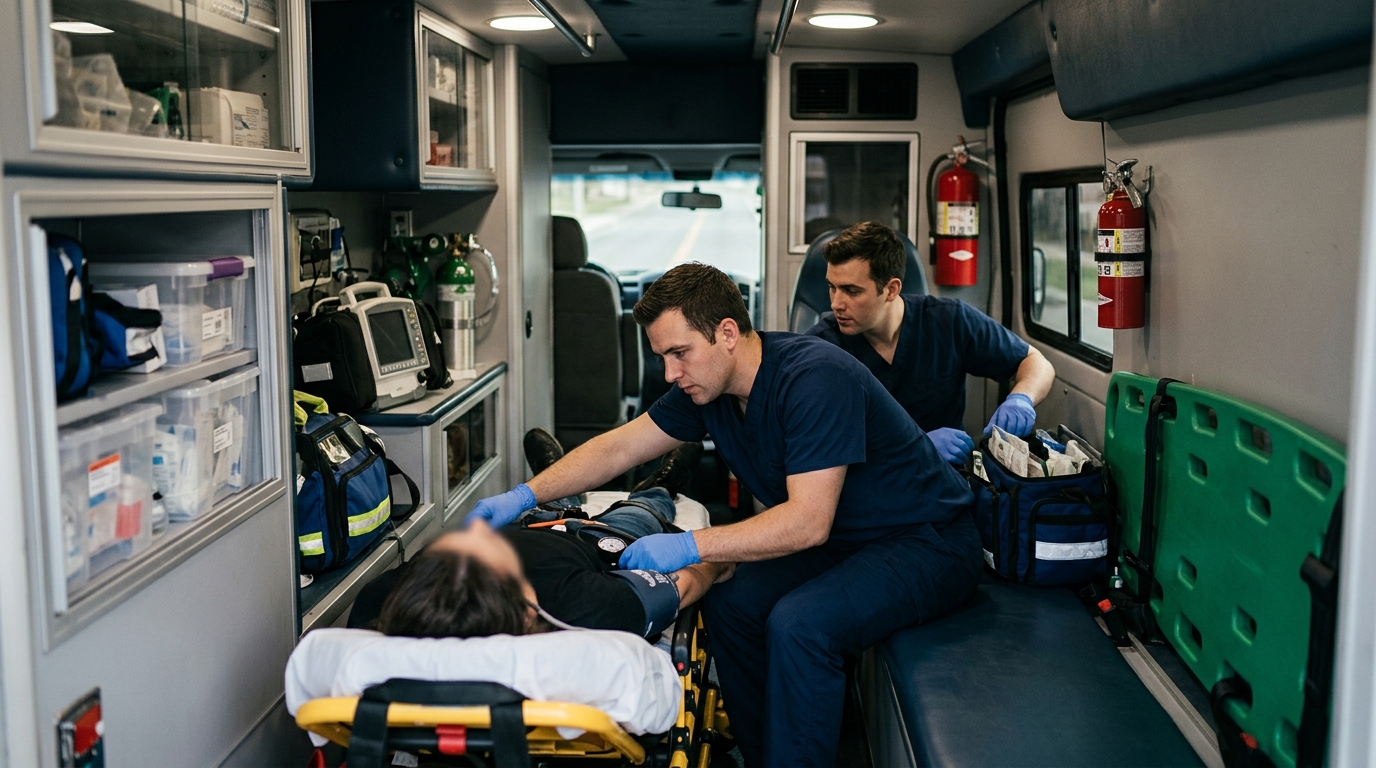
An EMT's day is built around two things: a vehicle that has to be ready at all times, and a radio that decides when you eat. Between calls you restock, clean, chart and wait; during calls you assess patients, provide treatment such as first aid or life support, and move people who cannot move themselves (U.S. Bureau of Labor Statistics, 2025).
This guide walks through a representative 6:00 a.m. to 6:00 p.m. shift on a transporting ambulance, names the equipment and software you touch, and sets out the credential steps in order. Shift lengths, call volume and protocols vary by employer and by state, so treat the clock times as one common pattern rather than a rule.
Job Snapshot
| Item | Detail, with source |
|---|---|
| Typical shift length | No single standard; most EMTs and paramedics work full time, some work more than 40 hours a week, and some work extended shifts (U.S. Bureau of Labor Statistics, 2025). Employers commonly build these into 8-, 12- or 24-hour rotations. |
| Most common schedule type | Rotating shifts that may include nights, weekends and holidays (U.S. Bureau of Labor Statistics, 2025). |
| Physical setting | Both indoors and outdoors, in all types of weather; the work is physically strenuous and may be stressful, especially in life-or-death situations (U.S. Bureau of Labor Statistics, 2025). |
| Minimum entry credential | A postsecondary nondegree award is the typical entry-level education, and all states require EMTs and paramedics to be licensed in the state where they work, with requirements varying by state (U.S. Bureau of Labor Statistics, 2025). |
| Training after hire | On-the-job training is typically needed to attain competency in the occupation (U.S. Bureau of Labor Statistics, 2025). |
| Most common employer type | Ambulance services employed about 46% of EMTs; local government, excluding education and hospitals, employed about 38% of paramedics (U.S. Bureau of Labor Statistics, 2025). |
| Preparation level | Job Zone Three, medium preparation, usually one or two years of training combining on-the-job experience and informal training with experienced workers (O*NET OnLine, U.S. Department of Labor, undated). |
Before the Workday Begins
For a 6:00 a.m. start, most crews arrive by 5:40 a.m., because the outgoing crew cannot leave until the truck has been signed over.
You come in wearing station uniform and boots, carrying a stethoscope, trauma shears, a penlight and your state license and certification cards. Before anything clinical happens, you and your partner walk the rig:
- Oxygen cylinder pressures, main and portable, plus spare regulator.
- Cardiac monitor or AED self-test, battery charge and spare battery; suction unit run for a few seconds.
- Airway bag, trauma bag and jump bag opened and checked against the inventory sheet, because supplies are replaced after use (U.S. Bureau of Labor Statistics, 2025).
- Stretcher rails, straps and hydraulics cycled; backboard, scoop and cervical collars present and the right sizes.
- Vehicle check: fuel, oil, tyres, warning lights, siren, and the mobile data terminal logged on so dispatch sees you as available.
- If you run with a paramedic, a two-person count of sealed controlled-substance pouches, signed on the drug log.
Anything missing goes on a supply request before 6:15 a.m., not after the first call. Commutes are usually driven, since you may be posted at a different station or street corner than the one you report to.
Hour by Hour Through the Shift
This is one 12-hour urban day shift. Call volume, posting policy and transfer work differ by employer and by whether you run for an ambulance service or a local fire department.
- 5:40 a.m. Arrive, sign in, take radio and portable from the charger.
- 6:00 a.m. Shift handover: the night crew flags a broken stretcher strap and a near-empty oxygen cylinder.
- 6:20 a.m. Complete the rig check sheet, swap the cylinder, note the strap for maintenance.
- 7:05 a.m. Dispatched to a ground-level fall in an apartment. Assess the patient, take vitals, splint a wrist, carry the stair chair down two flights.
- 8:10 a.m. Verbal handoff at the emergency department, then the electronic patient care report — documenting and reporting observations is a core duty (U.S. Bureau of Labor Statistics, 2025).
- 8:45 a.m. Decontaminate the stretcher and cot rails, restock bandaging, log the used supplies.
- 9:30 a.m. Posted at an intersection rather than the station, waiting on the next assignment.
- 10:30 a.m. Interfacility transfer: nursing home to dialysis, with paperwork, facility face sheet and a patient who does not want to go.
- 12:15 p.m. The part that regularly goes wrong. You open food at the station and the tones drop four minutes later for a chest pain call. The meal goes in the fridge; you may not get back to it.
- 1:40 p.m. Two-car collision. You immobilize a patient for stretcher and ambulance transport using a backboard or other spinal immobilization device (O*NET OnLine, U.S. Department of Labor, undated), working at the roadside in whatever weather there is.
- 3:10 p.m. Fuel the truck, wash blood off the floor, replace the cervical collar used earlier.
- 4:15 p.m. Patient declines transport. The refusal still takes 20 minutes of assessment, vitals and signatures.
- 5:48 p.m. Twelve minutes before end of shift, a call comes in for difficulty breathing. You take it, transport, and clear the hospital at 6:25 p.m.
- 6:40 p.m. Hand the rig to the night crew, finish the last chart, go home late.
Tools, Equipment, and Software Used Daily
- Mobile intensive care unit, driven following emergency dispatcher instructions (O*NET OnLine, U.S. Department of Labor, undated).
- Wheeled stretcher, stair chair and scoop stretcher.
- Backboard and other spinal immobilization devices, plus cervical collars (O*NET OnLine, U.S. Department of Labor, undated).
- Automated external defibrillator or cardiac monitor, depending on certification level.
- Bag-valve mask, oropharyngeal and nasopharyngeal airways, portable suction unit.
- Portable and main oxygen cylinders with regulators and non-rebreather masks.
- Blood pressure cuff, stethoscope, pulse oximeter, glucometer, thermometer.
- Splints, tourniquets, traction splint and burn dressings.
- Portable radio and the ambulance mobile data terminal for dispatch.
- Electronic patient care report (ePCR) software for charting each call.
- MEDITECH medical software at receiving facilities (O*NET OnLine, U.S. Department of Labor, undated).
- Epocrates or similar drug-reference retrieval software for checking medications (O*NET OnLine, U.S. Department of Labor, undated).
- Microsoft Office software for schedules, inventory sheets and training records (O*NET OnLine, U.S. Department of Labor, undated).
- Disinfectant wipes, sharps containers and gloves for cleaning equipment after use (U.S. Bureau of Labor Statistics, 2025).
The Toughest Part of the Job
The recurring problem is your body. EMTs and paramedics have one of the highest rates of injuries and illnesses of all occupations, from kneeling, bending and lifting while caring for and moving patients, and from exposure to diseases such as HIV (U.S. Bureau of Labor Statistics, 2025).
Here is where that shows up. At 2:10 a.m. on a night rotation you are called to a patient who has fallen in a narrow basement stairwell. The stretcher will not fit, so you and one partner carry the patient up thirteen steps in a stair chair, turning on a half-landing, with no room to use your legs properly. That single movement is more loading than most jobs ask for in a week, and you will do some version of it several times per rotation — in doorways, bathrooms, parked cars and on grass verges in the rain.
The second strain is the clock. Schedules may include nights, weekends and holidays (U.S. Bureau of Labor Statistics, 2025), and a call received at 5:48 p.m. does not end at 6:00 p.m. Plans made for right after a shift get broken often enough that experienced crews stop making them.
Signs This Job Fits Your Personality
- You can eat a meal in ten minutes and are not bothered when you have to abandon it halfway.
- You are comfortable touching strangers' bodies, including blood, vomit and incontinence, without visible reaction.
- You would rather work closely with one partner for twelve hours than alone or in a large team.
- You can give a clear verbal summary of what happened to someone who is not listening carefully.
- You finish paperwork the same day rather than letting charts stack up.
- You already exercise in a way that includes lifting, and your back and knees handle it.
- You can sleep at irregular times and wake up functional at 3:00 a.m.
- You keep speaking normally to people who are shouting, drunk or refusing help.
How to Break Into This Career
- Get and keep a clean driver's license (now). Employers typically require job candidates to have a driver's license and may prefer that they have ambulance driver certification (U.S. Bureau of Labor Statistics, 2025).
- Complete a CPR/BLS course (1 day). Most EMT programs require a current provider-level CPR card before your first clinical rotation.
- Enroll in an EMT-Basic certification program (typically less than 1 year). EMT-Basic programs usually take under a year; EMT-Intermediate programs take up to 2 years (U.S. Bureau of Labor Statistics, 2025). These run at community colleges, hospital-based training centers and some fire departments.
- Pass the National Registry EMT Certification Examination (sit it within weeks of finishing the course). It is a computerized adaptive test with a 2-hour time limit, requiring a minimum of 70 items and extending to a maximum of 120 items, including 10 unscored pilot items (National Registry of Emergency Medical Technicians, undated). Add the psychomotor or skills component your state requires.
- Apply for your state license (allow several weeks for processing). All states require EMTs and paramedics to be licensed in the state where they work, and requirements vary by state; CareerOneStop lists state licensing board requirements (U.S. Bureau of Labor Statistics, 2025).
- Apply directly to ambulance services and local government agencies. Ambulance services employed about 46% of EMTs, and local government, excluding education and hospitals, employed about 38% of paramedics (U.S. Bureau of Labor Statistics, 2025). Volunteer EMT work can also help with getting experience (U.S. Bureau of Labor Statistics, 2025).
- Expect on-the-job training after hire, then step up. On-the-job training is typically needed to attain competency (U.S. Bureau of Labor Statistics, 2025), and certification progresses from Emergency Medical Responder to EMT, Advanced EMT and Paramedic, each level adding skills such as IV fluids, medications, advanced airway management and EKG interpretation (U.S. Bureau of Labor Statistics, 2025). Paramedics typically need work experience as an EMT before entering a paramedic education program (U.S. Bureau of Labor Statistics, 2025).
Frequently asked questions
What is the difference between an EMT and a paramedic on a daily basis?
Certification levels run from Emergency Medical Responder to EMT, Advanced EMT, and Paramedic, with each level adding skills such as IV fluids, medications, advanced airway management and EKG interpretation (U.S. Bureau of Labor Statistics, 2025). On a two-person truck that usually means the paramedic runs the clinical side of serious calls while the EMT drives, assists and handles movement. Paramedics typically need work experience as an EMT before entering a paramedic program (U.S. Bureau of Labor Statistics, 2025).
How much of a shift is actually spent on emergency calls?
Less than new EMTs expect. Between calls you are inventorying and replacing supplies, cleaning equipment after use, and documenting and reporting observations (U.S. Bureau of Labor Statistics, 2025), and in many systems you also sit posted at an assigned corner rather than a station. A single call that lasts 45 minutes can generate 20 minutes of charting and restocking afterwards.
Do I need a college degree to start?
No. The typical entry-level education is a postsecondary nondegree award (U.S. Bureau of Labor Statistics, 2025), and O*NET rates the occupation Job Zone Three, medium preparation, usually one or two years of training including on-the-job experience and informal training with experienced workers (O*NET OnLine, U.S. Department of Labor, undated). A degree becomes relevant later if you move onward.
Can this lead to other healthcare jobs?
Yes. With additional education, paramedics may move into other healthcare occupations, for example through paramedic-to-RN programs that offer an accelerated pathway to becoming a registered nurse (U.S. Bureau of Labor Statistics, 2025). Many people use ambulance work as the clinical hours behind a later nursing, physician assistant or medical school application.
How do I find out what pay looks like where I live?
Pay is usually structured as an hourly rate with shift differentials for nights, weekends and holidays, plus overtime once you exceed your scheduled hours — relevant because some EMTs work more than 40 hours a week (U.S. Bureau of Labor Statistics, 2025). Check the current wage data in the BLS Occupational Outlook Handbook for your state and metro area, then compare it against live postings from local ambulance services and fire departments, since rates vary sharply by employer type and region.
Sources
- U.S. Bureau of Labor Statistics — EMTs and Paramedics : Occupational Outlook Handbook (2025)
- O*NET OnLine (U.S. Department of Labor) — 29-2042.00 - Emergency Medical Technicians

Written by
Desmond Okafor-Hale
Desmond writes about the mechanics of hiring: the forms, the filters, the strange rituals that decide who gets a callback. He's fascinated by the gap between what job postings say and what they mean.