What Does a Warehouse Associate Actually Do All Day?
From the first scan of a pick list to the last pallet wrapped and loaded, here is the shift structure, equipment and physical load behind the job title.
By Tobias Lindqvist · Oct 06, 2026 · 4 min read
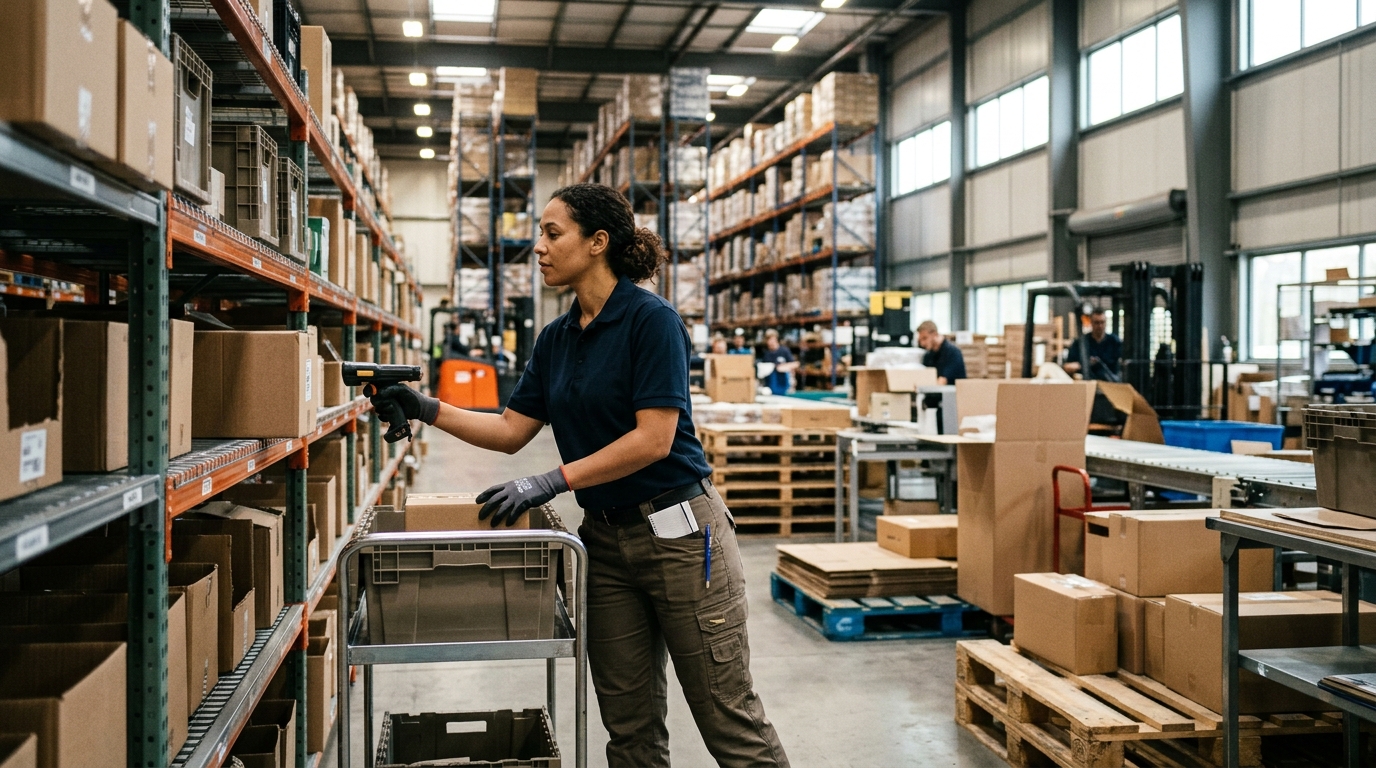
Warehouse associate work is built around a repeating cycle: receive stock, store it, pick it against an order, pack it, and load it out. Most of the shift is spent on your feet, moving between racking and conveyor lines with a handheld scanner, and the pace is set by the order volume for that day rather than by you.
This snapshot covers the hours, the environment, the tasks you repeat dozens of times a shift, and what employers actually require at hire.
At a Glance
| Factor | What to expect |
|---|---|
| Typical hours | Warehousing work can involve long shifts and overnight work, and schedules for hand laborers and material movers commonly include evenings and weekends (U.S. Bureau of Labor Statistics) |
| Work setting | Warehouses and storage facilities are among the main work settings listed for hand laborers and material movers (U.S. Bureau of Labor Statistics, 2025) |
| Physical demand | High: the occupation involves continual standing and repeated lifting, carrying and moving of goods (O*NET OnLine, 2024; U.S. Bureau of Labor Statistics, 2025) |
| Environment | Distracting or uncomfortable noise levels and daily exposure to contaminants such as dust and vehicle exhaust (O*NET OnLine, 2024) |
| Entry requirement | No formal educational credential; physical ability is the main hiring criterion and training is given on the job (U.S. Bureau of Labor Statistics) |
| Equipment limits | Only trained and competent operators may run a powered industrial truck such as a forklift (Occupational Safety and Health Administration) |
What a Typical Day Looks Like
On a day shift starting at 6:00 a.m., you clock in, collect your RF handheld barcode scanner, and put on the protective gear the site requires — steel-toe boots, hi-vis vest and often gloves or eye protection, since safety equipment is used daily in this occupation (ONET OnLine, 2024). A stand-up meeting at 6:10 a.m. covers the order count and any damaged stock from the night. You then log into your first pick path: the scanner directs you to a bin location, you confirm the barcode, count the units into a cart or tote, and move to the next aisle. Most hand laborers and material movers in warehouses do this job and are called pickers (U.S. Bureau of Labor Statistics). Around 9:30 a.m. you may switch to receiving — breaking down an inbound pallet, checking quantities against the packing list and putting stock away in racking. After a 12:00 p.m. break you move to outbound: shrink-wrapping pallets, applying shipping labels, and staging them at a dock door for a pallet jack or a certified forklift operator to load. Face-to-face discussion with supervisors and teammates happens every day (ONET OnLine, 2024), usually about counts that do not match. The last hour is cleanup: flattening cardboard, clearing aisles, and plugging in equipment before you clock out at 2:30 p.m.
Daily Tasks You'll Actually Do
- Scan a bin barcode with an RF handheld, count the units, and confirm the pick on screen.
- Break down an inbound pallet and check carton counts against the packing list.
- Put away received stock into assigned rack locations, including lower-level bins you must crouch to reach.
- Move loaded pallets short distances with a manual or electric pallet jack.
- Shrink-wrap a built pallet and apply the shipping label to the correct face.
- Stage finished pallets at a numbered dock door for loading.
- Report a count discrepancy or damaged carton to a supervisor in person.
- Flatten cardboard, sweep your aisle, and return scanners to the charging rack before clock-out.
Quick Fit Check
- Can you stand and walk for a full shift, since the occupation involves continual standing (O*NET OnLine, 2024)?
- Are you comfortable working where noise is loud enough to be distracting or uncomfortable (O*NET OnLine, 2024)?
- Can you lift and carry cartons repeatedly, which is the main hiring criterion employers test for (U.S. Bureau of Labor Statistics)?
- Will you wear steel-toe boots, a hi-vis vest and eye protection every shift (O*NET OnLine, 2024)?
- Can you work evenings, weekends or overnight shifts (U.S. Bureau of Labor Statistics)?
- Are you fine with almost no customer contact, but daily face-to-face talks with supervisors and teammates (O*NET OnLine, 2024)?
Frequently asked questions
Do I need a forklift certificate before I apply?
Usually not for a general associate role, because the Occupational Safety and Health Administration requires only that the operator be trained and competent before running a powered industrial truck, and that training is commonly given after hire. On-the-job training is typical for this occupation (U.S. Bureau of Labor Statistics, 2025), so ask at interview whether the site trains in-house.
Is "warehouse associate" the same job as "picker"?
Largely, yes. O*NET OnLine lists Warehouse Worker among the sample job titles for this occupation (2026), and the U.S. Bureau of Labor Statistics notes that most hand laborers and material movers in warehouses are called pickers, who retrieve goods and track what has been moved.
Sources
- U.S. Bureau of Labor Statistics — Hand Laborers and Material Movers : Occupational Outlook Handbook (2025)
- U.S. Bureau of Labor Statistics — Hand Laborers and Material Movers : Occupational Outlook Handbook (print version)

Written by
Tobias Lindqvist
Tobias writes on trades, apprenticeships, and the kinds of careers that don't start with a resume. He's interested in skill as a form of dignity, and in how little the discourse around work usually accounts for hands.