Electrician: A Day in the Life
From the 6:20 a.m. van stock check to the panel that will not de-energize at 2:40 p.m., here is how the working day actually breaks down on site.
By Harlan Voss · Oct 06, 2026 · 11 min read
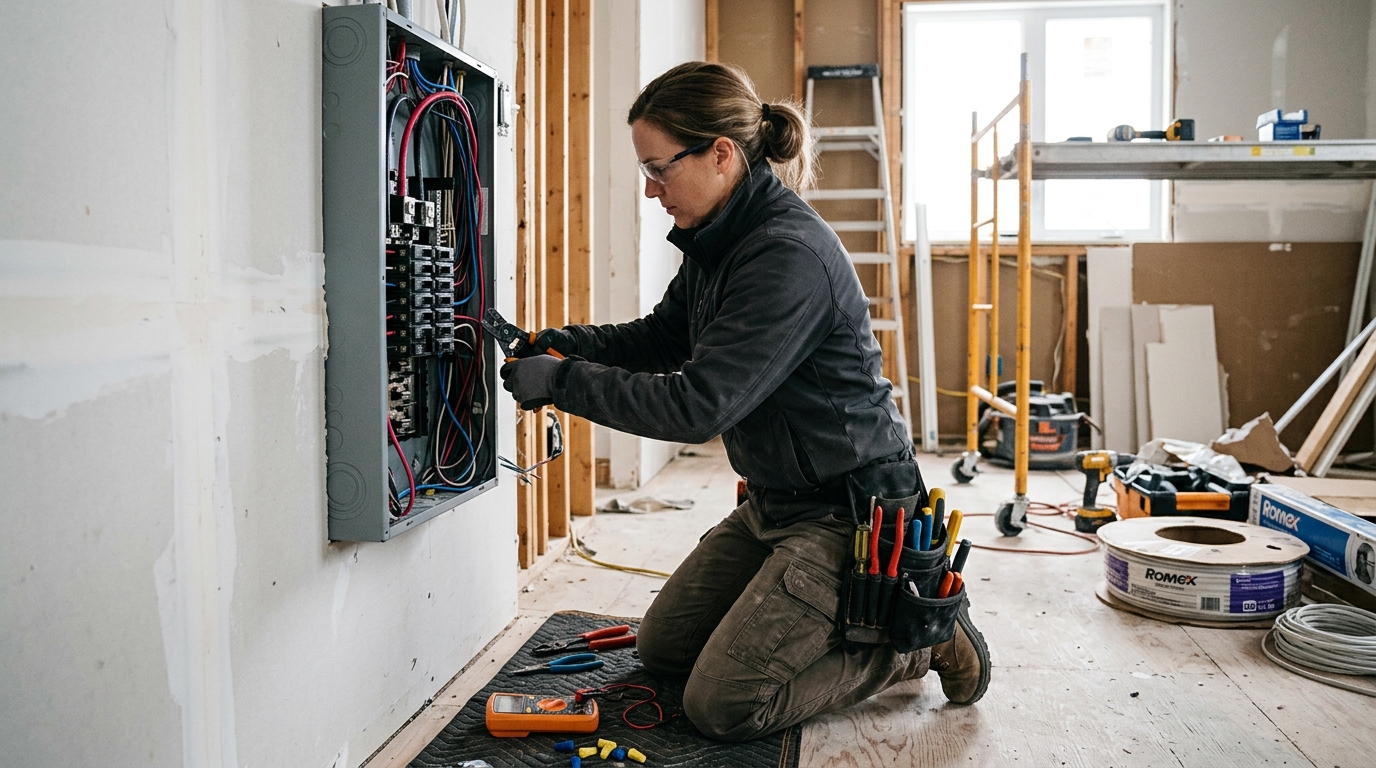
An electrician's day is built around a crew start time, a set of prints, and a punch list that other trades keep changing. Most of it is hands-on work in a building that is half-finished or half-broken: pulling and terminating conductors, testing circuits, troubleshooting what someone else installed, and standing or kneeling for long stretches while you do it.
This guide walks through a typical construction and service day hour by hour, names the tools and PPE you will carry, and sets out the apprenticeship and licensing route into the trade.
Job Snapshot
| Item | What the source says |
|---|---|
| Typical shift length | Full time — almost all electricians work full time; exact daily shift length is set by the employer and the project schedule (U.S. Bureau of Labor Statistics, 2025) |
| Most common schedule type | Fixed daytime crew shift for most construction work, but schedules may include evenings and weekends, and overtime is common; service electricians are frequently placed on an employer-set on-call rotation (U.S. Bureau of Labor Statistics, 2025) |
| Physical setting | Jobsites where electricians occasionally work in cramped spaces, stand and kneel for long periods, may be exposed to dirt, dust, debris or fumes, and may work at great heights (U.S. Bureau of Labor Statistics, 2025) |
| Minimum entry credential | BLS lists a typical entry-level education level and a long-term on-the-job training route; most electricians learn the trade in a 4- or 5-year apprenticeship with paid on-the-job hours plus technical instruction each year (U.S. Bureau of Labor Statistics, 2025) |
| License | Most states require electricians to pass a test and be licensed, and requirements vary by state; CareerOneStop lists state licensing board information (U.S. Bureau of Labor Statistics, 2025) |
| Largest employer | Electrical contractors and other wiring installation contractors (U.S. Bureau of Labor Statistics, 2025) |
| Self-employment | BLS publishes the share of electricians who are self-employed in the Occupational Outlook Handbook profile (U.S. Bureau of Labor Statistics, 2025) |
| Pay | BLS publishes a median annual wage for electricians in the Occupational Outlook Handbook; check that page and BLS state-level wage data for current figures, since rates differ sharply by state and by employer |
Before the Workday Begins
If you work for an electrical contractor — the industry that employs the most electricians (U.S. Bureau of Labor Statistics, 2025) — your day usually starts at a yard or straight at the gate, not at a desk.
A typical pre-shift routine runs like this:
- 5:45 a.m. — check the day's work order or text from the foreman to confirm which site you are on. Site changes overnight are normal when a crew gets pulled to cover an inspection.
- 6:20 a.m. — stock the van or gang box: MC cable, THHN spools, boxes, straps, anchors, breakers for the panel you are trimming, plus the material list for anything the warehouse still owes you.
- 6:35 a.m. — PPE check. Hard hat, safety glasses, gloves, safety shoes and hearing protection are the common protective equipment electricians report wearing (O*NET OnLine, U.S. Department of Labor). Add arc-rated clothing and voltage-rated gloves if you are working on or near energized gear.
- 6:45 a.m. — meters and prints. Confirm your multimeter and non-contact tester read a known live source, and pull up the current revision of the drawings, because working from a superseded sheet is the fastest way to install something twice.
Service electricians do the same checks but add a parts inventory and the day's call list, since the first address is usually a drive, not a parking lot.
Hour by Hour Through the Shift
Times below reflect a common 7:00 a.m. construction start. Service and industrial maintenance schedules shift the blocks, not the content.
- 6:55 a.m. — Sign in at the gate, badge the site, drop tools at the gang box.
- 7:00 a.m. — Toolbox talk and crew assignments. Electricians report having face-to-face discussions with individuals and within teams (O*NET OnLine, U.S. Department of Labor), and this is where the day's sequence, hazards and lockout/tagout plan get set.
- 7:20 a.m. — Layout on the second floor: mark box heights, snap lines, confirm dimensions against the prints. Being exact is rated important in this work (O*NET OnLine, U.S. Department of Labor) — a box set an inch off shows up in the drywall.
- 9:10 a.m. — Mount boxes and drill studs for homeruns. Long periods of standing and kneeling start to register here.
- 10:00 a.m. — The interruption. The general contractor moves the drywall crew up a day. You stop the rough-in you planned and pull homeruns on the walls being closed first, which means working in the ceiling space above the corridor — one of the cramped spaces BLS describes (U.S. Bureau of Labor Statistics, 2025).
- 11:30 a.m. — Lunch, usually on the tailgate or in the van.
- 12:00 p.m. — Pull and dress conductors into the panel, then terminate and torque breakers to spec.
- 1:45 p.m. — Troubleshooting call from the foreman: a receptacle circuit on a finished floor is dead. You trace it with a tester and an ammeter, find a backstabbed device that failed, and replace it.
- 2:40 p.m. — Second interruption. A circuit you need de-energized is feeding temporary lighting for another trade. You coordinate a shutdown window, apply lockout/tagout, and work around it.
- 3:15 p.m. — Label panel directory, mark up the as-built set, photograph open walls before close-in.
- 3:40 p.m. — Clean up debris, coil cords, secure the gang box, report progress and material shortages to the foreman.
- 4:00 p.m. — Shift ends — unless the inspection is tomorrow, in which case overtime, which BLS notes is common (U.S. Bureau of Labor Statistics, 2025), gets you to 6:00 p.m.
Tools, Equipment, and Software Used Daily
Electricians spend much of the day using their hands to handle, control or feel objects, tools and controls (O*NET OnLine, U.S. Department of Labor). The daily kit typically includes:
- Lineman's pliers, side cutters, needle-nose pliers and wire strippers
- Insulated screwdrivers and nut drivers
- Torque screwdriver and torque wrench for terminations
- Digital multimeter, clamp-on ammeter and a non-contact voltage tester
- Test lamps and, on controls and instrumentation work, an oscilloscope — ONET lists testing equipment such as oscilloscopes, ammeters and test lamps among electricians' tools (ONET OnLine, U.S. Department of Labor)
- Measuring devices: tape measure, laser distance meter, level, chalk line
- Power tools: cordless drill/driver, hole saws, band saw, hammer drill, reciprocating saw
- Conduit bender, threader and cable puller
- Power construction equipment and lifts, including scissor lifts and boom lifts for work at height (O*NET OnLine, U.S. Department of Labor)
- Fish tape, glow rods and labeling printer
- PPE: hard hat, safety glasses, gloves, hearing protection, safety shoes (O*NET OnLine, U.S. Department of Labor)
- Autodesk AutoCAD, listed by ONET as CAD software used by electricians, for drawings and markups (ONET OnLine, U.S. Department of Labor)
- Employer-issued phone or tablet for time entry, work orders, prints and photo documentation; the specific app varies by contractor
The Toughest Part of the Job
The recurring problem is position, not effort. A lot of the work happens where the building gives you no room: kneeling on a concrete deck to terminate devices at box height, lying in a ceiling space to land a homerun, or folding into a mechanical closet to land feeders in a panel with eight inches of clearance. BLS describes exactly this — occasional work in cramped spaces, long periods of standing and kneeling that can be tiring, and exposure to dirt, dust, debris or fumes (U.S. Bureau of Labor Statistics, 2025).
A concrete version: it is 1:15 p.m. in July, you are in an attic or a ceiling plenum above a corridor because the drywall crew is closing walls tomorrow, and the HVAC is not running yet. You are on your knees for two hours straight, drilling and pulling cable overhead, in heat and insulation dust. Nobody can swap in for you because the rest of the crew is on the floor below doing the same thing against the same deadline.
The second-order cost is cumulative: knees, shoulders and lower back. Electricians also need physical strength to move heavy components (U.S. Bureau of Labor Statistics, 2025), and wire spools, panels and transformers do not get lighter as the week goes on. Experienced hands manage it with knee pads, lifts instead of ladders where the site allows, and rotating the ugly tasks across the crew.
Signs This Job Fits Your Personality
- You can stop a task you are halfway through when the foreman reassigns you, and pick it back up the next day without losing your place.
- You check a measurement twice before you drill, because being exact is rated important in this work (O*NET OnLine, U.S. Department of Labor).
- You are comfortable kneeling, crouching or standing for most of an eight-hour stretch rather than sitting.
- You will wear a hard hat, safety glasses and hearing protection all day without taking them off when nobody is watching.
- You can work at height on a scissor lift or ladder without it affecting your hands.
- You talk through sequencing face to face with other trades instead of sending a message and hoping.
- You can follow a printed drawing and a written specification exactly, and flag the conflict when the two disagree.
- You can accept evening and weekend work and overtime when a deadline or inspection requires it (U.S. Bureau of Labor Statistics, 2025).
How to Break Into This Career
- Check your state's rules first (1–2 hours). Most states require electricians to pass a test and be licensed, and requirements vary by state; CareerOneStop lists state licensing board information (U.S. Bureau of Labor Statistics, 2025). Many states also require you to register as an apprentice or electrical trainee before you do any work on site.
- Apply to an apprenticeship program (application cycles vary; many sponsors open once or twice a year). Most electricians learn the trade in a 4- or 5-year apprenticeship with paid on-the-job training hours each year plus technical instruction (U.S. Bureau of Labor Statistics, 2025). Apply through joint labor-management apprenticeship committees, individual electrical contractors that sponsor registered programs, and your state apprenticeship agency's listings.
- Complete the apprenticeship (4–5 years). You work full time on site under licensed electricians and attend classroom instruction on wiring, code, and safety alongside it (U.S. Bureau of Labor Statistics, 2025). ONET classifies the occupation at a Job Zone level where considerable preparation — apprenticeship plus licensing — is needed (ONET OnLine, U.S. Department of Labor).
- Log and document your on-the-job hours as you go. States set their own hour thresholds: the Texas Department of Licensing and Regulation, for example, requires a minimum number of on-the-job training hours under a licensed Master Electrician before a Journeyman Electrician license application, with a smaller hour threshold that lets you sit the exam early (TDLR). Confirm the current hour counts with your own state board.
- Pass the journeyman licensing exam (study typically runs alongside your final apprenticeship year). The exam is state- or jurisdiction-administered and code-based.
- Work as a journey worker. After completing an apprenticeship, electricians are considered journey workers and may perform duties on their own, subject to local or state licensing requirements (U.S. Bureau of Labor Statistics, 2025). From there, further state licenses — such as a master electrician license — and self-employment are common next steps; BLS publishes the self-employed share in its occupational profile (U.S. Bureau of Labor Statistics, 2025).
Frequently asked questions
Is every electrician's day really different?
Within one trade, no — the sequence of layout, rough-in, trim and troubleshooting repeats. What changes is the building: construction electricians follow other trades' schedules, so your tasks reorder when drywall, HVAC or an inspector moves. Service electricians get more variety because each call is a different address and fault.
Do electricians work outside?
It depends on the segment. Residential and commercial interior work is largely indoors in unfinished or unconditioned space, while utility, solar and site work is outdoors. BLS notes electricians may be exposed to dirt, dust, debris or fumes and may work at great heights (U.S. Bureau of Labor Statistics, 2025), which covers both lift work indoors and rooftop work.
How much of the job is computer work?
Less than an hour a day for most field electricians, usually time entry, photos and drawing markups on a company phone or tablet. O*NET lists CAD software, specifically Autodesk AutoCAD, as a technology used by electricians (O*NET OnLine, U.S. Department of Labor), and that is mostly used by foremen, estimators and detailers rather than every hand on site.
Can I do this job if I'm not comfortable with heights?
You can in some segments, but it narrows your options. BLS states electricians may work at great heights (U.S. Bureau of Labor Statistics, 2025), and commercial work routinely means scissor lifts, boom lifts and ladder work for overhead conduit and lighting. Residential service and panel work keeps you closer to the ground.
How is pay usually structured in this trade?
Most electricians are paid an hourly rate that rises at set intervals during an apprenticeship and again at journey worker status, with overtime paid on hours beyond the standard week; overtime is common (U.S. Bureau of Labor Statistics, 2025). Self-employed electricians bill by the job or by the hour instead. Check the BLS Occupational Outlook Handbook and BLS state wage data for current figures rather than relying on recruiter estimates.
Sources
- U.S. Bureau of Labor Statistics — Electricians : Occupational Outlook Handbook (2025)
- O*NET OnLine (U.S. Department of Labor) — 47-2111.00 - Electricians

Written by
Harlan Voss
Harlan covers the business of job-seeking itself — the coaches, platforms, and advice industries that have grown up around finding work. He writes with a skeptic's patience and a soft spot for anyone still trying.