A Day in the Life of a Registered Nurse
From the 6:45 a.m. bedside handoff to the last late chart entry, here is how a hospital nursing shift actually runs and what keeps breaking it up.
By Tobias Lindqvist · Oct 06, 2026 · 11 min read
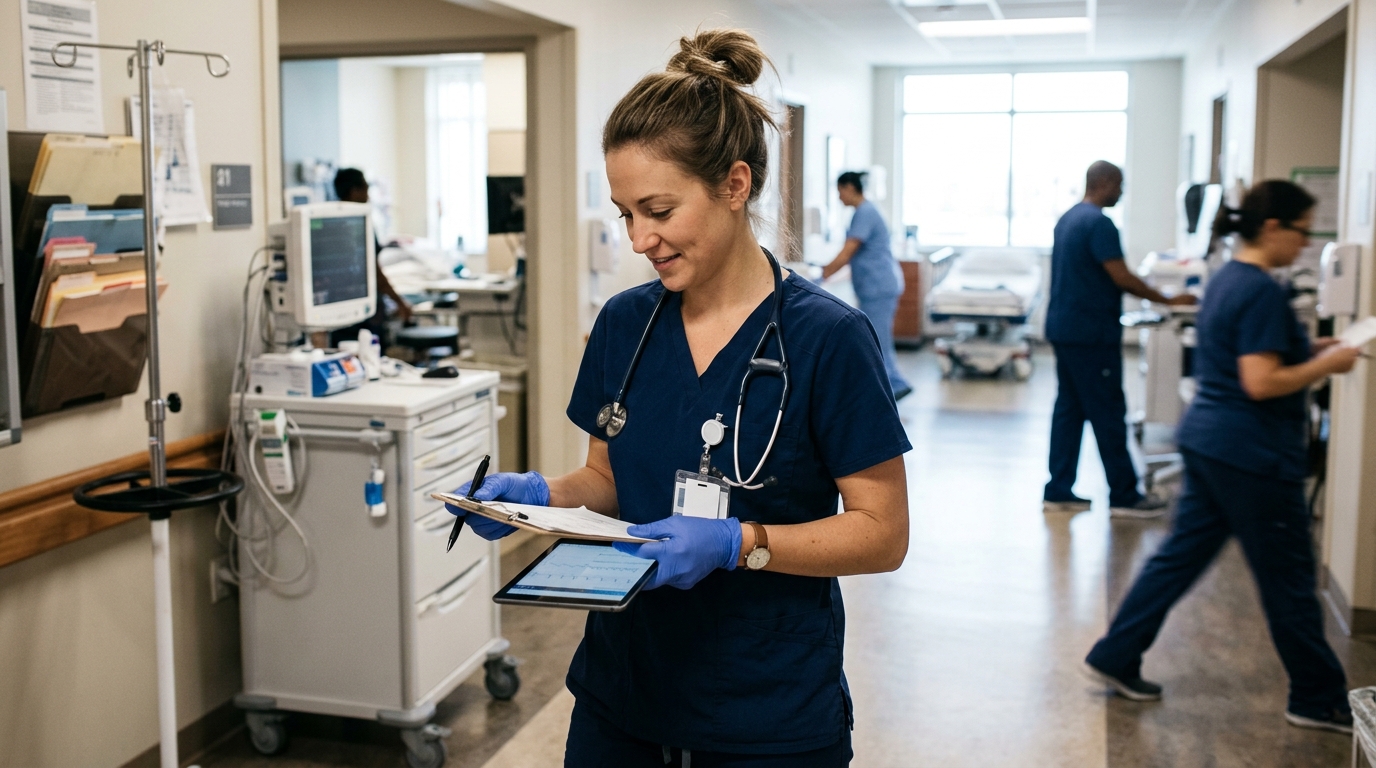
A registered nurse's day is built around three fixed points: the handoff that starts it, the medication times that anchor the middle, and the handoff that ends it. Everything between those points gets rearranged by admissions, call lights, and patients whose condition changes.
This guide walks through a hospital day shift hour by hour, names the equipment and software you touch, and sets out the licensing route into the job. Settings vary widely — hospital, clinic, nursing home, school — and so do hours, so check the specific posting and your state board of nursing for the rules where you plan to work.
Job Snapshot
| Item | What the sources say |
|---|---|
| Typical shift length | Not fixed nationally — hospitals and nursing care facilities run shifts to provide round-the-clock coverage, so length is set by the employer and stated in each posting (U.S. Bureau of Labor Statistics, 2026-08) |
| Most common schedule type | Shift work, including nights, weekends, and holidays, with on-call in hospitals and nursing care facilities; regular business hours in offices and schools that do not provide 24-hour care (U.S. Bureau of Labor Statistics, 2026-08) |
| Physical setting | Indoors, environmentally controlled every day according to 83% of respondents (O*NET OnLine, 2026); largest employers are hospitals, ambulatory healthcare services, nursing and residential care facilities, government, and educational services (U.S. Bureau of Labor Statistics, 2026-08) |
| Minimum entry credential | A bachelor's degree in nursing, an associate's degree in nursing, or a diploma from an approved program, plus a license issued by the state where you work and a passing score on a qualifying exam (U.S. Bureau of Labor Statistics, 2026-08) |
| Common add-on certifications | CPR, basic life support (BLS), or advanced cardiac life support (ACLS), depending on the position (U.S. Bureau of Labor Statistics, 2026-08) |
| Daily exposure | Exposed to disease or infections every day according to 61% of respondents (O*NET OnLine, 2026) |
Before the Workday Begins
If your shift starts at 7:00 a.m., you are usually in the building by 6:20 a.m. Parking garages near hospitals fill early, and badge access, lockers, and scrub changes all happen before the clock starts.
What you actually do in those forty minutes:
- Check the assignment board or staffing sheet to see which rooms you have and who your charge nurse is for the day.
- Pull your own gear out of your bag: stethoscope, trauma shears, pupil light, badge reel, and a pen that works. Most nurses carry two.
- Log into the electronic health record at a workstation and pre-read your patients — diagnoses, overnight events, scheduled medications, pending labs, code status, allergies, fall risk, and isolation precautions.
- Write your own brain sheet: a folded page with room numbers down the side and time slots across the top for medications, dressing changes, and glucose checks.
- Pick up a unit phone or secure messaging device and test that it rings.
If a patient is on contact or droplet precautions, you check gown and glove stock outside that room before 6:45 a.m., because you will not want to hunt for it mid-assessment.
Hour by Hour Through the Shift
This is one hospital medical-surgical day shift. Hours differ in a clinic, a school, or an operating room, because only facilities providing 24-hour care need shift coverage (U.S. Bureau of Labor Statistics, 2026-08).
- 6:45 a.m. — Bedside handoff with the night nurse, room by room: overnight vitals, pain control, IV site condition, drains, and anything the physician was called about.
- 7:10 a.m. — First full round. Head-to-toe assessments, lung and bowel sounds, telemetry check, armband and allergy band verification, IV pump rate confirmation.
- 8:00 a.m. — Morning medication pass. Pull from the automated dispensing cabinet, scan the patient's wristband and each barcode, and document administration as you go.
- 9:15 a.m. — Physician rounds. You report an overnight temperature spike and get an order for blood cultures, then draw them before the next antibiotic dose.
- 10:00 a.m. — Dressing change on a post-op abdominal wound, plus charting the two assessments you did not finish at 7:10 a.m.
- 11:30 a.m. — The plan breaks. The emergency department calls report on an unplanned admission arriving in fifteen minutes, while a call light goes off in a room where a confused patient is trying to climb over the bed rail. You delegate the bed setup, go to the fall risk first, and your 11:30 a.m. charting moves to 1:00 p.m.
- 12:40 p.m. — Lunch, taken late and with your phone handed to a covering nurse. Some days it is twenty minutes at a workroom counter.
- 1:30 p.m. — Discharge teaching: wound care, new prescriptions, red-flag symptoms, and follow-up appointment, explained to the patient and a family member, then documented.
- 2:45 p.m. — A patient's oxygen saturation drops. You raise the head of the bed, apply oxygen, call respiratory therapy, and page the physician.
- 4:00 p.m. — Afternoon medication pass and blood glucose checks; one patient needs a new peripheral IV after the old site infiltrates.
- 5:30 p.m. — Catch-up charting: intake and output totals, pain reassessments, and the care plan notes you owe from the morning.
- 6:45 p.m. — Handoff to the night nurse.
- 7:15 p.m. — Still at a computer finishing a note. Leaving late is common and is the main reason a scheduled shift and an actual shift differ.
Tools, Equipment, and Software Used Daily
- Epic Systems, MEDITECH, and eClinicalWorks EHR software — all listed as Hot Technologies for this occupation (O*NET OnLine, 2026)
- Automated medication dispensing cabinet, accessed by badge or fingerprint
- Barcode scanner for wristband and medication verification
- Smart IV infusion pumps with drug library limits
- Vital signs monitor and telemetry cardiac monitoring
- Pulse oximeter and glucometer
- Stethoscope, blood pressure cuff, and thermometer
- Crash cart with defibrillator, used in codes and checked each shift
- Portable bladder scanner
- Safety-engineered needles and sharps containers
- Gowns, gloves, face shields, and N95 respirators for isolation rooms
- Ceiling or floor patient lift, gait belt, and slide sheet
- Unit phone or secure messaging device for physician and lab calls
The Toughest Part of the Job
The recurring physical problem is moving people who cannot move themselves. Registered nurses spend a lot of time walking, bending, stretching, and standing, and are vulnerable to back injuries because they often must lift and move patients (U.S. Bureau of Labor Statistics, 2026-08).
Here is where it bites. At 3:10 p.m. a 220-pound post-operative patient has slid toward the foot of the bed and needs repositioning before pressure builds on the sacrum. The lift team is tied up on another floor, the aide is on break, and the patient is in pain and cannot help you. You either wait and let the patient stay in a bad position, or you pull in whoever is free and boost with a slide sheet. Nurses do this several times a shift, every shift, for years.
The second recurring strain is infection exposure: 61% of ONET respondents reported exposure to disease or infections every day (ONET OnLine, 2026), and the job also brings contact with hazardous drugs, needle-stick risk, and radiation or chemical exposure, which is why gowning, double-gloving, and sharps protocols are enforced rather than suggested (U.S. Bureau of Labor Statistics, 2026-08).
Signs This Job Fits Your Personality
- You can stop a task at the halfway point, handle something urgent, and come back to the first task without losing your place.
- You are comfortable talking to strangers all day — 96% of ONET respondents reported face-to-face discussions with individuals and teams every day (ONET OnLine, 2026).
- You will say out loud that you are unsure and ask a colleague to double-check a dose.
- You can be in a room with vomit, wounds, or a patient who is shouting at you, and still finish the assessment.
- You do not mind writing things down immediately and in a set format, several dozen times a shift.
- You can work a holiday or an overnight without resenting it, since hospital and nursing care facility schedules include nights, weekends, holidays, and on-call (U.S. Bureau of Labor Statistics, 2026-08).
- You notice when something small has changed — breathing rate, skin color, a patient who is quieter than yesterday — and act before being told.
- You accept responsibility for other people's safety; 66% of ONET respondents reported very high responsibility for the health and safety of other workers (ONET OnLine, 2026).
How to Break Into This Career
- Pick an approved education path (2–4 years). Registered nurses usually take one of three routes: a bachelor's degree in nursing, an associate's degree in nursing, or a diploma from an approved nursing program (U.S. Bureau of Labor Statistics, 2026-08). BSN programs typically take 4 years, ADN and ASN degrees are also listed as typically taking 4 years, and hospital or medical-center diploma programs typically take 2 to 3 years (U.S. Bureau of Labor Statistics, 2026-08).
- Complete clinical rotations inside the program. These are built into approved programs and are where you first do medication passes, assessments, and charting under a preceptor. Ask admissions which hospitals the school places students in before you enroll.
- Apply to your state board of nursing and pass the qualifying exam (allow 1–3 months after graduation). You must hold a license issued by the state in which you work, which requires graduating from an approved program and passing a qualifying exam (U.S. Bureau of Labor Statistics, 2026-08). For the NCLEX-RN, candidates get a maximum of five hours, the exam ends after a minimum of 85 and a maximum of 150 questions, and the exam costs $200 (Kaplan Test Prep, citing National Council of State Boards of Nursing exam rules).
- Get CPR, BLS, or ACLS certification before you apply (1–2 days per course). Positions may require any of these (U.S. Bureau of Labor Statistics, 2026-08), and hiring managers often want the card in hand at interview.
- Apply for staff nurse roles through hospital new-graduate residency postings and community health openings. Most registered nurses begin as staff nurses in hospitals or community health settings (U.S. Bureau of Labor Statistics, 2026-08). Apply directly through hospital career portals, and also look at nursing and residential care facilities, ambulatory healthcare services, government, and educational services, which are among the largest employers (U.S. Bureau of Labor Statistics, 2026-08).
- Plan the next credential after 1–2 years on a unit. With experience, performance, and continuing education, staff nurses advance to assistant clinical nurse manager, charge nurse, or head nurse (U.S. Bureau of Labor Statistics, 2026-08). Clinical nurse specialists must earn a master's degree in nursing and typically already have 1 year or more of work experience as an RN or in a related field (U.S. Bureau of Labor Statistics, 2026-08).
Frequently asked questions
Do all registered nurses work nights and weekends?
No. Nurses in hospitals and nursing care facilities work in shifts to provide round-the-clock coverage and may work nights, weekends, holidays, and on-call (U.S. Bureau of Labor Statistics, 2026-08). Nurses in offices, schools, and other places that do not provide 24-hour care are more likely to work regular business hours (U.S. Bureau of Labor Statistics, 2026-08). If predictable hours matter to you, filter your job search toward clinics, school nursing, and ambulatory settings.
Am I on my feet the entire shift?
Less than people assume. Among O*NET respondents, 54% said they spend time standing less than half the time (O*NET OnLine, 2026). The rest of the shift involves walking between rooms, bending over beds, and sitting at a workstation to chart — which is also why back strain from lifting, not standing alone, is the injury nurses are warned about.
What does the day-to-day task list actually include?
Core duties are assessing patients' conditions, recording medical histories and symptoms, administering medicines and treatments, consulting with doctors and other healthcare professionals, operating and monitoring medical equipment, and teaching patients and families how to manage illnesses or injuries (U.S. Bureau of Labor Statistics, 2026-08). In a single shift you will usually do all six. The teaching piece — explaining a new medication or wound care to a family member — takes longer than new nurses expect.
Does the job look different depending on specialty?
Yes, and the structural reason is the setting's patient flow. Reported job titles for this occupation include Emergency Department RN, Operating Room Registered Nurse, Oncology RN, Psychiatric RN, School Nurse, Charge Nurse, and Staff Nurse (O*NET OnLine, 2026). An operating room nurse's day is organized around a case list, while an emergency department nurse's day is organized around arrivals they cannot predict.
How long does it take to go from zero to working as an RN?
The education itself runs 2 to 4 years depending on the path — diploma programs typically take 2 to 3 years, while BSN, ADN, and ASN programs typically take 4 years (U.S. Bureau of Labor Statistics, 2026-08). After graduation you add licensure processing and the qualifying exam, which for the NCLEX-RN is a single sitting of up to five hours and 85 to 150 questions (Kaplan Test Prep, citing National Council of State Boards of Nursing exam rules). Check your state board of nursing for its own application timeline, since processing varies by state.
Sources
- U.S. Bureau of Labor Statistics — Registered Nurses : Occupational Outlook Handbook (2026-08)
- O*NET OnLine (U.S. Dept. of Labor) — 29-1141.00 - Registered Nurses (2026)

Written by
Tobias Lindqvist
Tobias writes on trades, apprenticeships, and the kinds of careers that don't start with a resume. He's interested in skill as a form of dignity, and in how little the discourse around work usually accounts for hands.