Social Worker or Counselor? Comparing Two Paths for Career Changers
Both paths lead to licensed practice, but the degree route, the licensing exam and the weekly rhythm of the work differ more than the job titles suggest.
By Desmond Okafor-Hale · Oct 06, 2026 · 10 min read
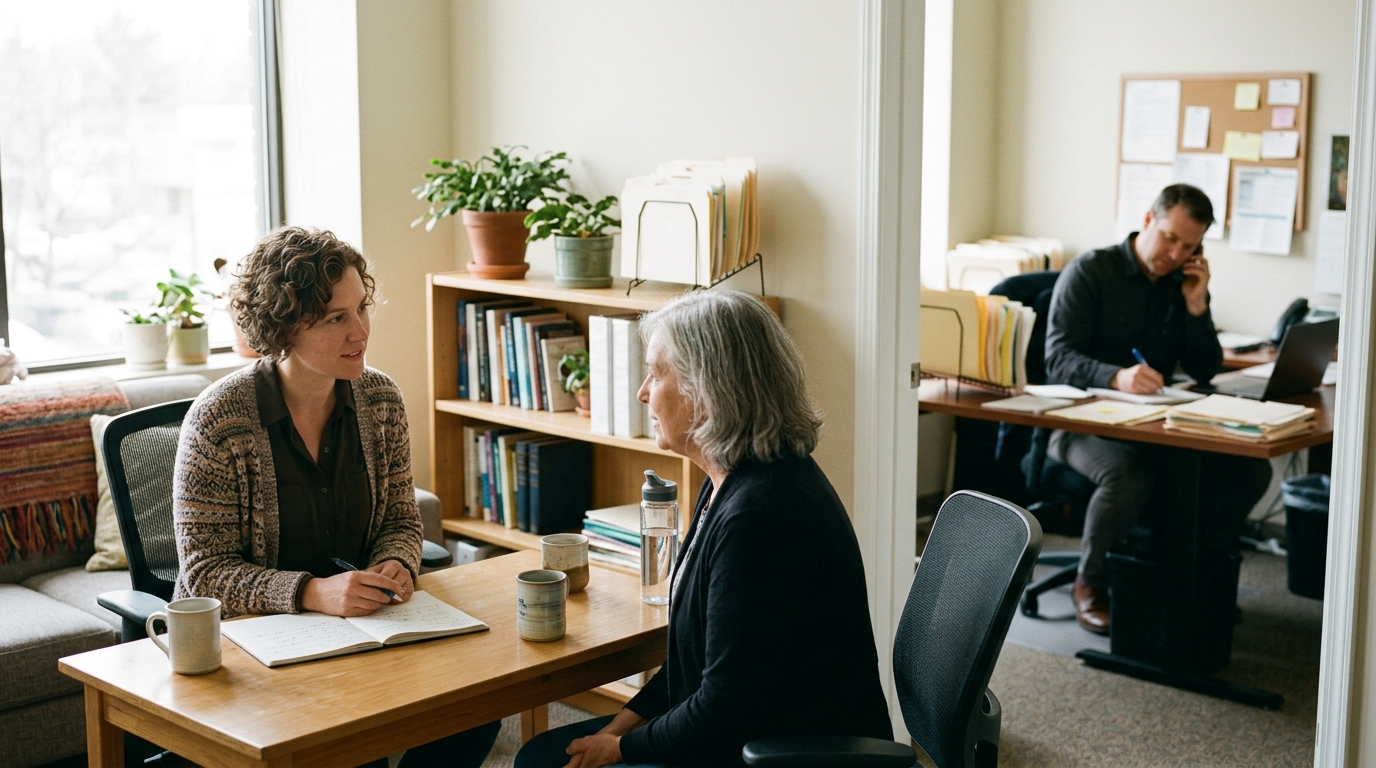
Social work and counseling overlap enough that career changers often apply to both without noticing the differences. The federal data separates them: social workers had a 2025 median pay of $61,780 a year, counselors in the substance abuse, behavioral disorder and mental health group had $59,350 (U.S. Bureau of Labor Statistics, 2025), and the two fields use different licensing exams run by different bodies.
This guide lines the two up across entry requirements, exams, daily tasks, hours and outlook, then shows which prior careers transfer more cleanly into each. Licence titles and requirements are set state by state, so treat your own state board's rules as the final word on anything here.
Side-by-Side Comparison
Both columns describe licensed helping work with case notes, treatment plans and clients in crisis. The differences show up in which degree gets you in the door, which board tests you, and how much of the week you spend sitting versus moving between settings.
| Dimension | Social worker | Substance abuse, behavioral disorder and mental health counselor |
|---|---|---|
| Entry requirements | A bachelor's or master's degree in social work, and in many cases a licence; clinical social workers need a master's, supervised clinical experience and a licence from the state where they practise (U.S. Bureau of Labor Statistics, 2025) | Substance abuse and behavioral disorder counselors typically need at least a bachelor's degree; mental health counselors typically need a master's degree and an internship, and some roles require a state-issued licence (U.S. Bureau of Labor Statistics, 2025) |
| Licensing exam | The ASWB exam: 122 multiple-choice questions, 110 scored plus 12 unscored pretest items, with a four-hour limit, covering values and ethics, assessment and planning, and intervention and practice (AATBS) | The National Counselor Examination: 200 items, 160 scored plus 40 pretest, used for NBCC's National Certified Counselor credential and by many state boards for licensure (National Board for Certified Counselors) |
| Exam cost and types | $230 for the Associate, Bachelors or Masters exam and $260 for the Advanced Generalist or Clinical exam, nonrefundable; four exam types matched to your degree and career goal (Association of Social Work Boards) | NCE eligibility requires a master's in counseling or a closely related field from a regionally accredited institution, including coursework in NBCC's eight required content areas, ideally from a CACREP-accredited programme (CounselingDegreesOnline.org) |
| Credential names | Depending on the state, those who pass the ASWB Clinical exam and meet state requirements may hold LCSW, CSW, LISW, LSCSW, LCSW-C or LICSW (AATBS) | The National Certified Counselor credential is a voluntary national certification, not a state licence; a state licence must be obtained separately for private practice counseling (Georgia State University College of Education and Human Development) |
| 2025 median pay | $61,780 a year, or $29.70 an hour (U.S. Bureau of Labor Statistics, 2025) | $59,350 a year, or $28.53 an hour (U.S. Bureau of Labor Statistics, 2025) |
| Day-to-day tasks | Mental health and substance abuse social workers counsel clients individually or in groups, collaborate with physicians, nurses and counselors to plan treatment, and monitor and record client progress toward treatment goals (O*NET OnLine) | Mental health counselors perform crisis interventions, assess patients for risk of suicide attempts, develop and implement treatment plans, and maintain required treatment records and progress notes (O*NET OnLine) |
| Schedule and hours | No single federal figure; hospital, child-welfare and hospice posts often add on-call rotations or home visits, so check the hours line on each job posting and ask about after-hours duty at interview | Mental health counselors usually work 40 hours a week (Illinois workNet, drawing on O*NET occupational data) |
| Physical demands | Varies by setting — healthcare and community roles mix desk documentation with ward rounds, home visits and travel between sites | Mental health counselors frequently sit for long periods of time (Illinois workNet, drawing on O*NET occupational data) |
| Difficult interactions and teamwork | For healthcare social workers, working with or contributing to a work group or team was rated extremely important by 73% of respondents, and dealing with unpleasant, angry or discourteous people happens once a week or more for 52% (O*NET OnLine) | Crisis intervention and suicide risk assessment are listed core tasks, so distress is built into the caseload rather than an exception (O*NET OnLine) |
| Job outlook, 2025–35 | Faster than average (U.S. Bureau of Labor Statistics, 2025) | Much faster than average (U.S. Bureau of Labor Statistics, 2025) |
Two practical notes. First, pay in both fields moves with state, employer type and setting — a county agency, a hospital system and a nonprofit outpatient clinic will not pay the same for the same credential, so check current figures on the Bureau of Labor Statistics occupational pages and on live postings in your metro area. Second, the licence you can hold is a state decision. The ASWB and NBCC exams are national products, but the title, supervised-hour count and renewal rules come from your state board.
Who Tends to Thrive in Each
The hospital-floor coordinator who moves into social work. If you have spent three or four years as a medical-surgical nurse, discharge planner or hospital unit clerk, the social work column will feel familiar fast. Mental health and substance abuse social workers collaborate with physicians, nurses and counselors to plan treatment and monitor progress toward treatment goals (ONET OnLine), which is the same multi-party coordination you already do when a patient's discharge depends on a pharmacy, a family member and a bed somewhere else. The teamwork load is measurable: 73% of healthcare social worker respondents rated contributing to a work group or team as extremely important (ONET OnLine). The same background also prepares you for the friction — 52% of those respondents deal with unpleasant, angry or discourteous people once a week or more. If the part of nursing you liked was the family conference and the part you disliked was the ten minutes per patient, social work moves that ratio in your favour, though it costs you a master's degree, supervised clinical experience and a state licence if you want clinical practice (U.S. Bureau of Labor Statistics, 2025).
The peer recovery specialist or classroom teacher who moves into counseling. If you have run a 12-week group programme, taught the same 30 students daily for a year, or worked as a recovery peer support worker, the counseling column rewards what you already do: a repeating caseload, session-by-session, with written progress notes. Mental health counselors develop and implement treatment plans, maintain required treatment records and progress notes, and perform crisis interventions including assessing patients for risk of suicide attempts (ONET OnLine). The working pattern is more predictable than hospital social work — usually 40 hours a week, with long periods of sitting (Illinois workNet, drawing on ONET data). The entry ramp is also shorter on one branch: substance abuse and behavioral disorder counseling typically needs at least a bachelor's degree, while mental health counseling typically needs a master's plus an internship (U.S. Bureau of Labor Statistics, 2025). Teachers in particular tend to adapt well to the documentation volume, having already written IEP notes and parent communications to a deadline.
Transferable Skills by Background
- Registered nurse, EMT or medical assistant → social work. The skill that carries is interdisciplinary care coordination: agreeing a plan with a physician, a pharmacist and a family in one conversation. That is close to the listed social work task of collaborating with physicians, nurses and counselors to plan treatment and monitoring client progress toward treatment goals (O*NET OnLine), and it matches the 73% of healthcare social workers who call team contribution extremely important. Budget for the master's in social work plus the $260 ASWB Clinical exam fee, which is nonrefundable, if clinical licensure is the goal (Association of Social Work Boards).
- K-12 teacher or school paraprofessional → counseling. The skill that carries is structured session delivery with written documentation: you already plan a 45-minute block toward an objective, then record what happened. Mental health counselors develop and implement treatment plans and maintain required treatment records and progress notes (ONET OnLine). The sitting-heavy, roughly 40-hour week (Illinois workNet, drawing on ONET data) is a smaller change for a teacher than hospital on-call rotations would be. Check whether your target programme meets NBCC's eight required content areas and is CACREP-accredited before you enrol, since NCE eligibility depends on that coursework (CounselingDegreesOnline.org).
- HR generalist, benefits administrator or employee relations specialist → social work. The skill that carries is navigating entitlement systems and documenting sensitive conversations that may be reviewed later. Social work roles lean on resource navigation and progress recording, and the field's own gatekeeping is systems-heavy: four ASWB exam types matched to degree and career goal, a 122-question four-hour exam, and a licence title that may be LCSW, CSW, LISW, LSCSW, LCSW-C or LICSW depending on the state (AATBS; Association of Social Work Boards).
- Police officer, probation officer or 911 dispatcher → counseling, specifically substance abuse and behavioral disorder work. The skill that carries is rapid risk triage under time pressure, which maps onto the counselor tasks of crisis intervention and assessing patients for risk of suicide attempts (O*NET OnLine). This branch also has the shortest formal ramp of the four routes here: substance abuse and behavioral disorder counselors typically need at least a bachelor's degree, while mental health counseling typically requires a master's and an internship (U.S. Bureau of Labor Statistics, 2025).
If you are drawn to the work itself rather than one title, do one concrete thing before enrolling anywhere: ask your state licensing board which exam it accepts — the ASWB exam for social work or the National Counselor Examination for counseling — and get the supervised-hour requirement in writing, because that number, not the degree, usually sets how long the switch takes.
Frequently asked questions
Which pays more, social work or counseling?
On the 2025 federal medians, social work is slightly ahead: $61,780 a year against $59,350 for substance abuse, behavioral disorder and mental health counselors (U.S. Bureau of Labor Statistics, 2025). Hourly, that is $29.70 versus $28.53 — a gap of about $1.17 an hour, which is small enough that setting, state and employer type will often matter more than the job title. Check the current Bureau of Labor Statistics occupational pages and live postings in your own metro before assuming either number applies to you.
Which one takes less time to retrain into?
The fastest documented route is substance abuse and behavioral disorder counseling, which typically needs at least a bachelor's degree, while mental health counseling typically requires a master's plus an internship (U.S. Bureau of Labor Statistics, 2025). Social work can be entered with a bachelor's or master's in social work, but clinical practice requires a master's, supervised clinical experience and a state licence. The exam day itself is short on the social work side: the ASWB exam gives you four hours for 122 questions, of which 110 are scored and 12 are unscored pretest items (AATBS).
Does passing the national exam mean I can open a private practice?
Not by itself on the counseling side. The National Certified Counselor credential is a voluntary national certification, not a state licence, and a state licence must be obtained separately to do private practice counseling (Georgia State University College of Education and Human Development). The NCE itself is 200 items, 160 scored and 40 pretest, and many state boards use it as part of licensure (National Board for Certified Counselors). For social work, passing the relevant ASWB exam plus meeting state requirements can lead to titles such as LCSW, LISW or LICSW depending on the state (AATBS).
Which field is growing faster?
Counseling, on the federal projections: the outlook for substance abuse, behavioral disorder and mental health counselors for 2025–35 is described as much faster than average, while social work is faster than average over the same period (U.S. Bureau of Labor Statistics, 2025). Faster growth is not a hiring guarantee in any one county, so pair the projection with a count of how many current openings in your state ask for an LCSW-type licence versus a counseling licence.
Sources
- U.S. Bureau of Labor Statistics — Social Workers : Occupational Outlook Handbook (2025)
- U.S. Bureau of Labor Statistics — Substance Abuse, Behavioral Disorder, and Mental Health Counselors : Occupational Outlook Handbook (2025)
Written by
Desmond Okafor-Hale
Desmond writes about the mechanics of hiring: the forms, the filters, the strange rituals that decide who gets a callback. He's fascinated by the gap between what job postings say and what they mean.