Is a Career in Nursing Right for You? A Second-Career Self-Assessment
A clear look at 12-hour hospital shifts, state licensing rules and the accelerated degree routes open to people who already hold a bachelor's in another field.
By Desmond Okafor-Hale · Oct 06, 2026 · 9 min read
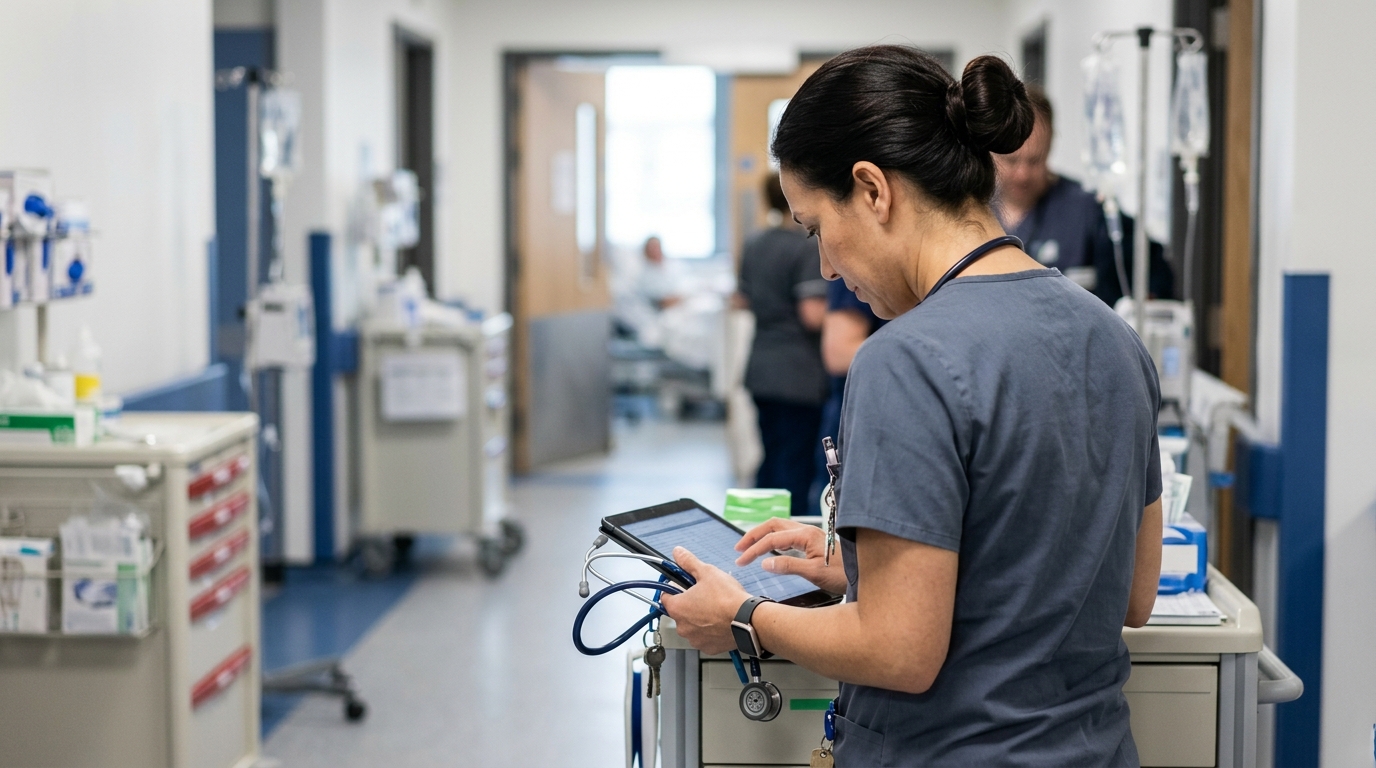
Nursing is one of the few licensed clinical careers with a built-in entry route for people who already finished a degree in something else. The U.S. Bureau of Labor Statistics (2025) lists a bachelor's degree as the typical entry-level education for registered nurses, with no prior experience in a related occupation required, and notes that accelerated programs exist specifically for people who hold a bachelor's in another field.
This guide is a self-assessment, not a sales pitch. It covers what a shift actually contains, which skills from teaching, accounting, restaurant work and the military carry over, and the concrete checks to run before you pay a single application fee.
What the Work Actually Looks Like
Most nursing work happens in hospitals: they employ 59% of registered nurses, followed by ambulatory healthcare services at 19%, nursing and residential care facilities at 6%, government at 5% and educational services at 3% (U.S. Bureau of Labor Statistics, 2025).
Hospital units commonly schedule nurses in three long shifts a week rather than five short days. The Bureau of Labor Statistics (2025) notes that nurses in hospitals and nursing care facilities work shifts to provide round-the-clock coverage, may work nights, weekends and holidays, and may be on call. Nurses in offices and schools are more likely to work regular business hours.
A medical-surgical day shift usually opens with handoff from the night nurse: a structured verbal report plus a scan of each patient's chart in the electronic health record. You then do your first rounds — assessing patients' conditions, taking vital signs, checking IV sites and infusion pumps, listening to lungs and bowel sounds, and recording histories and symptoms (U.S. Bureau of Labor Statistics, 2025).
The rest of the shift is a rolling queue of named tasks: scanning barcodes and administering medicines and treatments at scheduled times, hanging IV fluids, drawing blood or assisting with diagnostic tests, operating and monitoring equipment such as telemetry monitors, pulse oximeters and glucometers, consulting with doctors on changed orders, and updating care plans (U.S. Bureau of Labor Statistics, 2025). Discharges mean teaching patients and families how to manage an illness or injury at home — wound care, inhaler technique, when to call.
Some registered nurses also oversee licensed practical nurses, nursing assistants and home health aides as part of a care team with physicians and other specialists (U.S. Bureau of Labor Statistics, 2025), so part of your shift is delegating and checking work rather than doing it yourself.
Charting fills every gap, and often the last 30 to 60 minutes. Physical stamina matters because you are on your feet for most of a shift (U.S. Bureau of Labor Statistics, 2025). Job growth for registered nurses over 2025-35 is projected to be faster than average (U.S. Bureau of Labor Statistics, 2025).
Skills That Transfer
- Teaching (K-12 classroom): explaining the same concept three different ways for different learners maps directly onto patient education — teaching a newly diagnosed diabetic to draw up insulin, then checking teach-back before discharge.
- Restaurant serving or shift leading: holding six tables, their order timings and their special requests in your head is the same working-memory task as running four to six patients whose medications, tests and meal holds are all due at different clock times.
- Bookkeeping or audit work: reconciliation habits and audit trails become medication administration record accuracy — right patient, right drug, right dose, right time, right route — where detail orientation is listed by the Bureau of Labor Statistics (2025) as a core RN quality.
- Military service, including medic and corpsman roles: working a chain of command, following protocol under time pressure and triaging casualties transfer to code response and to advanced cardiac life support (ACLS) algorithms.
- Pharmacy technician work: dosage calculation, unit conversion and double-checking labels shorten the learning curve on pharmacology coursework and on IV drip rate math.
- Call centre or customer service work: de-escalation scripts and staying level with an angry caller transfer to families at the bedside demanding answers you are not yet allowed to give.
- Social work or case management: discharge planning, benefits navigation and documenting contacts transfer to coordinating a patient's transfer to a skilled nursing facility and to contributing to care plans.
- Project management in software or construction: daily standups and written handovers transfer to shift-change report, where omitting one pending lab result has consequences.
- Veterinary technician work: placing catheters, drawing blood, monitoring anaesthesia and restraining a frightened animal transfer to IV starts, specimen collection and safe repositioning of patients.
- Firefighting or EMT work: rapid patient assessment, vital signs and scene handover translate into emergency department triage and into the critical-thinking skills the Bureau of Labor Statistics (2025) lists for registered nurses.
Signs This Career Fits You
These are checkable, not personality quiz answers. Tick the ones that are already true of you.
- You can stay on your feet for most of a 12-hour stretch — the Bureau of Labor Statistics (2025) lists physical stamina, including being on your feet for most of a shift, as a required quality.
- You can work nights, weekends and holidays, or be on call, without it breaking your childcare or caregiving arrangements (U.S. Bureau of Labor Statistics, 2025).
- You can go back to full-time study for 11 to 15 months, the range covered by example accelerated second-degree BSN programs (Pace University; RegisteredNursing.org), and you have a plan for income during that time.
- Your undergraduate GPA clears the bar programs set — one listed accelerated BSN requires a minimum of 2.9 (RegisteredNursing.org).
- You check your own work twice by habit: counting cash drawers, proofing invoices, re-reading a spec before sending it.
- Bodily fluids, wounds and the smell of a dressing change do not stop you functioning — spend 8 hours on a unit to find out rather than guessing.
- You are comfortable being supervised closely for your first year and, later, overseeing licensed practical nurses and nursing assistants yourself (U.S. Bureau of Labor Statistics, 2025).
- You would pass a criminal background check, which is among the requirements that vary by state for nursing licensure (U.S. Bureau of Labor Statistics, 2025).
How to Start Exploring This Path
- Spend 8 to 16 hours on a unit within the next month. Ask a hospital volunteer office or a nursing home about shadowing or volunteer shifts. Onboarding often involves a background check and immunisation records, so start the paperwork two to four weeks before you want to be on the floor. Volunteering is usually unpaid, so count the hours as a cost.
- Book a CPR or basic life support (BLS) course and block one weekend day for it. Registered nursing positions may require CPR, BLS or advanced cardiac life support (ACLS) certification (U.S. Bureau of Labor Statistics, 2025). Prices vary by provider and city — ask the training centre for the current fee before you register.
- Call your state board of nursing and spend one afternoon on its website. Licensure requires graduating from an approved nursing program and passing a qualifying exam, with other requirements such as a background check varying by state (U.S. Bureau of Labor Statistics, 2025). Get the approved-program list in writing before you shortlist schools.
- Decide which rung you are aiming at, over about two weeks. The Bureau of Labor Statistics (2025) describes three RN education paths: a bachelor's degree, an associate's degree, and a diploma from an approved hospital or medical-centre program, typically 2 to 3 years. Licensed practical and vocational nursing is a postsecondary nondegree award, with certificate or diploma programs typically about 1 year (2025). Nursing assistants complete a state-approved program and pass a state competency exam, and must be on the state registry to work in a nursing home (2025).
- Audit your transcript against prerequisites in weeks three and four. If you already hold a bachelor's in another field, accelerated nursing degree programs exist for exactly that situation (U.S. Bureau of Labor Statistics, 2025). Examples include an 11-month, 51-credit full-time accelerated BSN (Pace University), a 12-month full-time program with a weekend option for working professionals, and a 15-month, 95-credit program with a 2.9 GPA minimum and a $0 application fee (RegisteredNursing.org).
- Compare five programs side by side over four weeks. Call each registrar for total cost of attendance, start dates, clinical placement arrangements and NCLEX-RN preparation. Note which charge an application fee and which, like the 15-month example above, charge $0 (RegisteredNursing.org).
- Build a 12-to-18-month money plan before you accept a seat. Match it to the length of the program you chose — 11, 12 or 15 months of full-time study in the examples above — plus the weeks between graduation and licensure while you sit the exam and wait on your state board.
Frequently asked questions
Can I become a nurse if my degree is in business, English or another non-nursing field?
Yes — accelerated nursing degree programs exist for people who want to enter nursing and already hold a bachelor's in another field (U.S. Bureau of Labor Statistics, 2025). One example runs 11 months full-time across 51 credits (Pace University). You will still need to complete science prerequisites, which many applicants take separately beforehand, so ask each program which courses it requires and how recent they must be.
Should I work as a CNA or LPN first to test whether nursing suits me?
It is a short, low-commitment test. Nursing assistants complete a state-approved program and pass a state competency exam, then appear on a state registry — required to work in a nursing home (U.S. Bureau of Labor Statistics, 2025). Titles vary by state. LPN or LVN certificate programs typically take about one year, with optional certifications later in gerontology, wound care or IV therapy (2025).
Is a nursing licence valid in every state?
Registered nurses must hold a licence issued by the state where they work (U.S. Bureau of Labor Statistics, 2025). Requirements beyond graduating an approved program and passing the qualifying exam, such as a criminal background check, vary by state. If you expect to move, ask both state boards directly about their rules rather than relying on a school's summary.
How long before I could become a nurse practitioner?
Advanced practice registered nurses, including nurse practitioners, need at least a master's degree in their specialty, an RN licence, a passed national certification exam and a state APRN licence (U.S. Bureau of Labor Statistics, 2025). That sits on top of your initial degree, so plan it as a second stage once you have bedside experience, not as part of your career-change timeline.
Sources
- U.S. Bureau of Labor Statistics — Registered Nurses : Occupational Outlook Handbook (2025)
- U.S. Bureau of Labor Statistics — Licensed Practical and Licensed Vocational Nurses : Occupational Outlook Handbook (2025)

Written by
Desmond Okafor-Hale
Desmond writes about the mechanics of hiring: the forms, the filters, the strange rituals that decide who gets a callback. He's fascinated by the gap between what job postings say and what they mean.