How to Become a Drone Pilot
The FAA's Part 107 certificate is the gate for paid drone work, but what you fly, who hires you and what the rules allow varies by state and employer.
By Marisol Teague · Oct 06, 2026 · 9 min read
Flying a drone for any commercial purpose in the United States means holding a Remote Pilot Certificate with a small UAS rating, issued by the FAA. Getting it is a short, cheap, mostly administrative process: an aeronautical knowledge test, an online application and a TSA background check. The longer work is everything after — building flight time, a portfolio and a specialism that an employer or client will actually pay for.
This guide walks through the credential, the realistic timeline, and what to have ready before you book a test date. Rules outside the US are set by that country's own civil aviation authority, and state and local laws add their own restrictions on where you can take off and land.
Step-by-Step Path
There is no minimum education requirement and no mandated number of training hours for the Part 107 certificate — you pass a test and clear a background check (CredentialGuide, undated). The hiring part is on you.
- Confirm you are eligible and create an IACRA profile (one evening). You must be at least 16 years old to hold a remote pilot certificate with a small UAS rating, and able to read, speak, write and understand English; the FAA can impose operating limitations for medical reasons (eCFR, National Archives/GPO, undated). Before you can book the exam you need a free FAA Tracking Number, obtained by creating a profile on the IACRA website (The Drone U, undated).
- Study for the Unmanned Aircraft General (UAG) knowledge test (2–6 weeks). Most candidates dedicate 20–40 hours to preparation (eci2fly, undated). The material is aviation theory, not stick time: reading sectional charts, airspace classes, METAR and TAF weather products, loading and performance, crew resource management, and the operating rules in Part 107. Optional online prep courses run roughly $50–$300 (GroundScholar, undated); self-study from free FAA study material is a legitimate route.
- Pass the knowledge test at a testing centre (one morning). The exam is 60 multiple-choice questions with a two-hour limit and a 70% minimum passing score — 42 of 60 — administered at a PSI testing centre (The Drone U, undated). There are around 800 FAA-approved knowledge testing centres across the United States (Drone Pilot Ground School, undated), and the fee is approximately $175 (Federal Aviation Administration, undated). Score below 70% and you wait 14 calendar days to retake it, paying the fee again (faa107exam.com, undated).
- Apply for the certificate and clear security vetting (days to weeks). Passing the test is not the final step: you apply for the Remote Pilot Certificate through IACRA and complete the required security vetting (PilotWrittenPrep, undated). That includes a Transportation Security Administration background check, which happens automatically during the application (Drone Pilot Ground School, undated). The licence is issued by the FAA's UAS Integration Office (CareerOneStop, 2023-05-24).
- Register each aircraft you fly commercially (one afternoon). Registration costs $5 per aircraft for commercial use and lasts three years before re-registration (GroundScholar, undated; Indeed, undated). Mark the registration number on the airframe and keep proof with you when you fly.
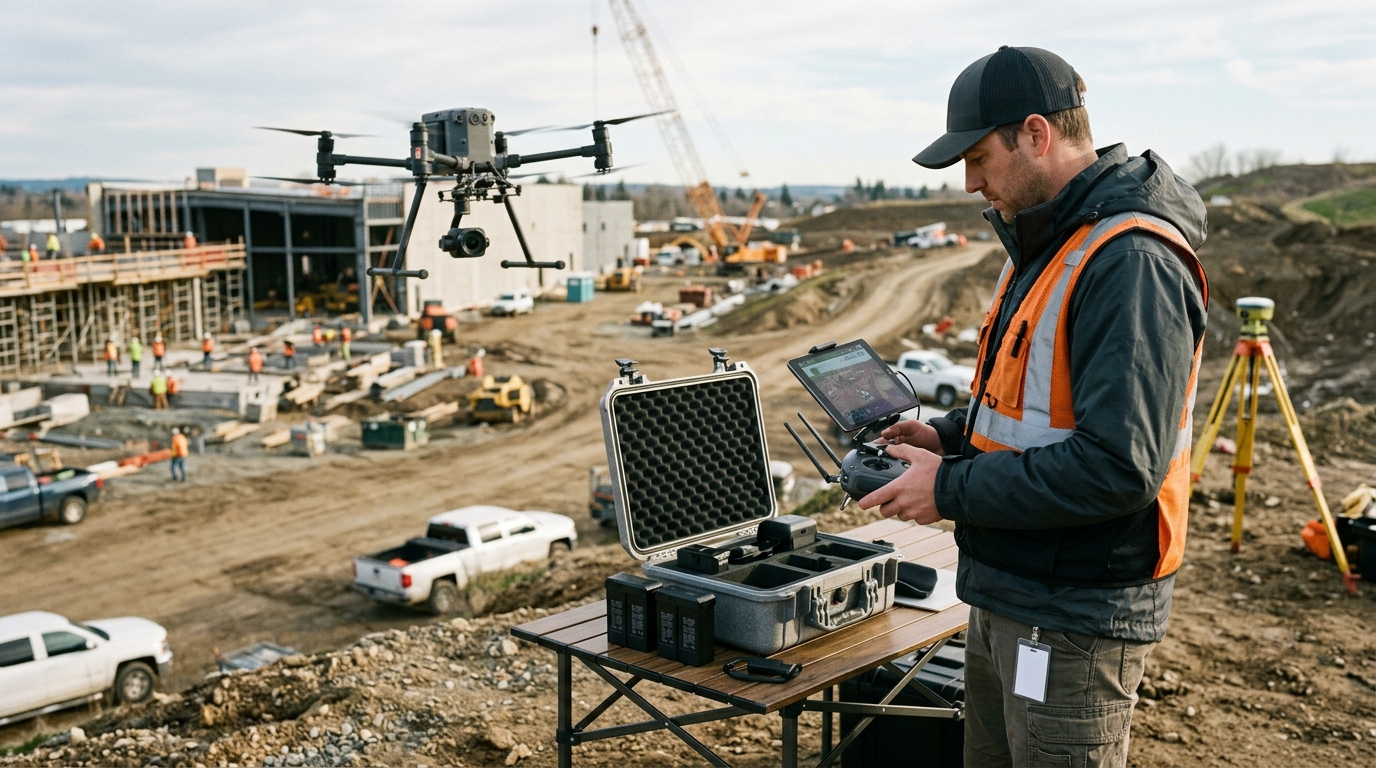
- Take an entry-level flying or support role (3–12 months). Realistic first titles are visual observer, drone operator, UAS field technician or junior remote pilot on a subcontract roster. Expect to run preflight checklists, request airspace authorisation where controlled airspace applies, log batteries and flight times, fly pre-planned grid missions with set front and side overlap for photogrammetry, swap ND filters and calibrate gimbals for video, and hand raw imagery to a processing team that builds orthomosaics and point clouds.
- Specialise in one deliverable (6–18 months). Pick a lane: thermal roof and solar inspection, powerline and tower work, construction progress mapping, public safety support, agricultural NDVI surveys or cinematography. Specialisation usually means learning the client's software and reporting format, not another FAA credential — though operations beyond the standard rules, such as flying over people or beyond visual line of sight, require specific FAA waivers or authorisations you apply for per operation.
- Keep your aeronautical knowledge current (every 24 months, about two hours). The certificate itself has no expiration date; what must be refreshed every 24 calendar months is your knowledge recency under 14 CFR 107.65 (LegalClarity, undated). Since the rule change effective 6 April 2021, that is a free self-paced online course — ALC-677 for most pilots, or ALC-515 for current Part 61 pilots (RotatePilot, undated).
- Move into senior or programme roles (2–5 years in). Titles include chief pilot, UAS programme manager, geospatial or aerial data analyst, and training lead. These jobs are won on documented safety records, written standard operating procedures and data quality — not on hours alone. No certificate guarantees a job offer.
How Long It Takes
The paperwork is fast. The employability takes longer, and depends on the sector you target and the state you fly in.
| Stage | Milestone |
|---|---|
| Weeks 0–6 | FAA Tracking Number issued through IACRA, 20–40 hours of UAG study completed (eci2fly, undated), test booked at one of roughly 800 testing centres (Drone Pilot Ground School, undated). |
| Months 1–2 | Knowledge test passed, IACRA application submitted, TSA vetting cleared, temporary then permanent Remote Pilot Certificate in hand — the whole process typically runs one to two months (CredentialGuide, undated). |
| Months 2–6 | Aircraft registered for commercial use; 50–100 logged flights in varied wind, light and airspace; a portfolio with at least one video edit and one mapping deliverable; first paid work as a visual observer, subcontract pilot or UAS field technician. |
| Months 6–18 | A chosen specialism with repeatable deliverables — thermal inspection reports, construction orthomosaics, or broadcast-ready footage. Written checklists and a maintenance log that a client's safety officer will accept. |
| Years 2–5 | Full-time staff pilot or operations role, or a steady freelance client base. First recency refresh completed via the free online course every 24 calendar months (RotatePilot, undated). Possible move into chief pilot or UAS programme management. |
Two things stretch this. First, drone flying is rarely a standalone job: in many organisations it is one duty attached to a surveyor, inspector, photographer, journalist or public safety role, so the hiring timeline is really the hiring timeline for that profession. Second, demand is uneven — one industry summary cites 3% projected job growth from 2019 to 2029 and an average salary around $58,350 a year (American Society of Civil Engineers, undated). Treat that as a reason to pair flying with a second skill, and check the Bureau of Labor Statistics directly for the most recent figures.
Pay structure varies: staff roles are salaried, freelance work is usually day-rate or per-deliverable, and some inspection contracts pay per asset surveyed. Rates differ sharply by state, sector and whether you supply your own aircraft and insurance.
Before You Start
Mark these off before you book a test date or send a single application.
- An FAA Tracking Number. Free, obtained by creating a profile on the IACRA website, and required before scheduling the knowledge test (The Drone U, undated).
- Government-issued photo identification. You will need valid ID at the testing centre, and your name must match your IACRA profile exactly.
- Proof you meet the age rule. You must be at least 16 to hold the certificate (eCFR, National Archives/GPO, undated). You can sit the test at 14 but cannot apply for or receive the certificate until you turn 16 (Red Raven UAS, undated).
- A budget line of roughly $175–$475. That covers the $175 knowledge test, optional prep courses at $50–$300, and $5 per aircraft for commercial registration valid three years (GroundScholar, undated; Indeed, undated). Aircraft, batteries and insurance are extra.
- Full-length practice exams scored above the pass mark. Sit timed 60-question mocks until you are clearing the 70% minimum with margin (The Drone U, undated) — including the chart-reading and weather questions, which are where most people lose marks.
- A written preflight checklist and flight log template. Clients and employers ask to see them. Include airframe and battery serial numbers, cycle counts, weather observations and airspace checks.
- Two finished portfolio pieces. One edited video or stills set, and one data deliverable such as an orthomosaic or a thermal inspection sheet. Shoot both legally in uncontrolled airspace before you have paid work.
- A read-through of your state and local rules. Takeoff and landing restrictions in parks, state privacy statutes and local ordinances vary considerably; airspace is federal, but the ground under you often is not. Outside the US, check your own national civil aviation authority's requirements instead.
Frequently asked questions
What does it actually cost beyond the certificate?
Reaching the certificate runs about $175–$475 all in (GroundScholar, undated). The real spending starts afterwards: an aircraft suitable for paid work, spare batteries, memory cards, a tablet, case and propellers, plus liability insurance, which many clients require. Insurance is priced per policy or per flight and varies by state, coverage limit and sector. Processing software for mapping work is usually a monthly subscription.
I'm 14 or 15 — is there anything I can do now?
Yes. You can sit the Part 107 knowledge test at 14, but you cannot apply for or receive the Remote Pilot Certificate until you turn 16 (Red Raven UAS, undated). In the meantime, fly recreationally within the rules for recreational flyers, build editing and photogrammetry skills, and keep a flight log. Note the test result's validity window before timing your attempt.
Do I need a degree or any flying background?
No. The Part 107 certificate has no minimum education requirement and no specified training hours — you pass the aeronautical knowledge test and clear a background check (CredentialGuide, undated). Manned-aircraft pilots get a shorter route to recency training, but they are not advantaged in hiring. What employers look at is your deliverables, your safety documentation and the second skill you bring: surveying, inspection, agronomy or video.
Can I do this while working full time?
The study load is the only real demand: 20–40 hours for most candidates (eci2fly, undated), which fits into evenings over a month. Testing centres are widespread, with around 800 FAA-approved sites nationally (Drone Pilot Ground School, undated), so a single weekday morning off usually covers the exam. Building a portfolio on weekends is slower but workable, and much early drone work is part-time or project-based anyway.
What happens if my knowledge recency lapses?
The certificate itself never expires; what lapses is your aeronautical knowledge recency under 14 CFR 107.65, which must be refreshed every 24 calendar months (LegalClarity, undated). Since the rule change effective 6 April 2021, that refresh is a free self-paced online course — ALC-677, or ALC-515 for current Part 61 pilots (RotatePilot, undated). You complete it and resume operating; there is no retest and no new fee.
Sources
- eCFR (National Archives/GPO) — 14 CFR Part 107 -- Small Unmanned Aircraft Systems (FAR Part 107)
- Federal Aviation Administration — UAS Pilot Testing, Certification and Responsibilities (Aeronautical Information Publication, Chap 11 Sec 5)

Written by
Marisol Teague
Marisol oversees how Preferred Careers thinks about work itself — not just how to get a job, but why certain ones feel worth keeping. She's drawn to the quiet negotiations people make between ambition and sanity, and edits with an eye for the sentence that gives the game away.