Dental Hygienist Career Path: Step-by-Step
Dental hygiene is a licensed clinical job built on an accredited degree, two board exams, and state rules that differ wherever you plan to work.
By Priya Nandakumar · Oct 06, 2026 · 9 min read
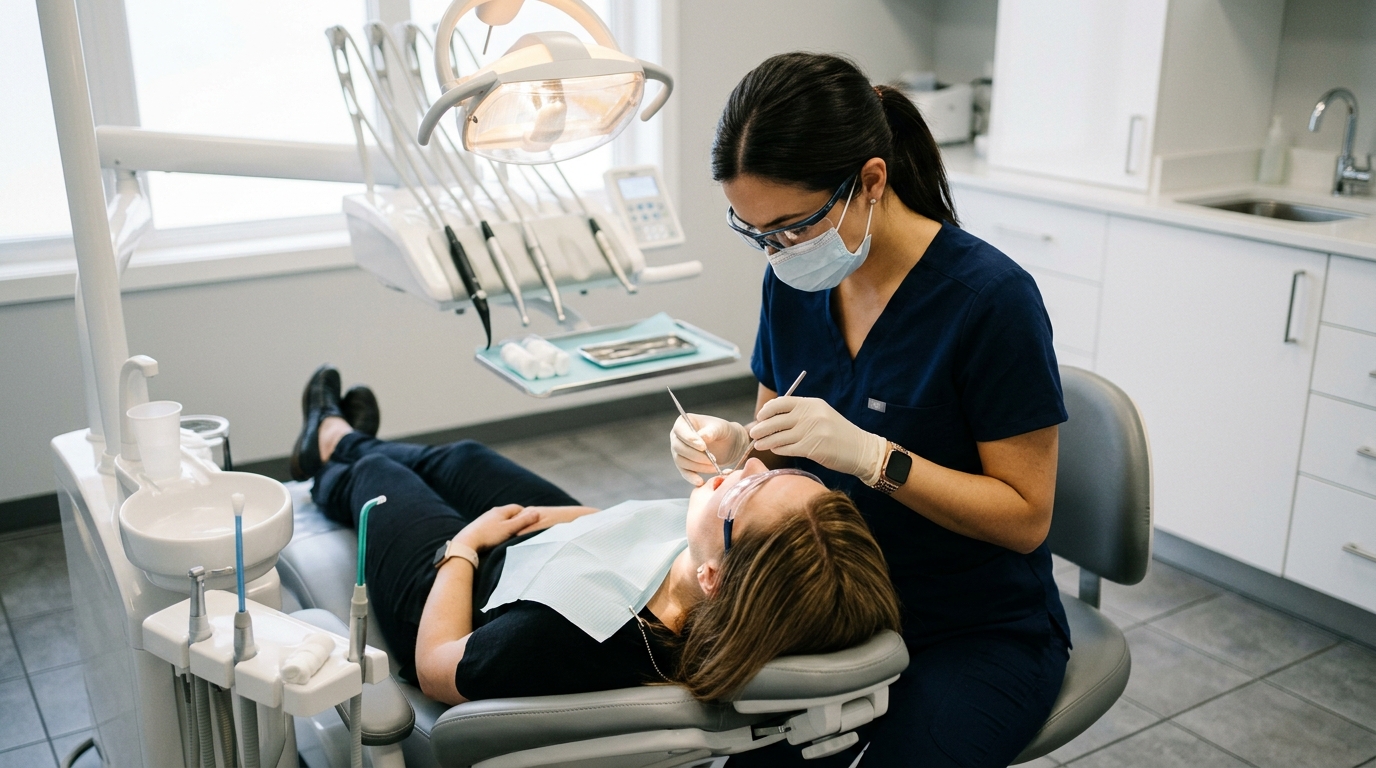
Becoming a dental hygienist means finishing an accredited dental hygiene program, passing a written national board exam and a clinical board exam, and holding a license in the state where you work. Every state requires licensure, and in most states that means a degree from an accredited program plus passing written and clinical exams, with continuing education to keep the license current (U.S. Bureau of Labor Statistics, 2025).
This guide lays out the steps in order, how long each stage realistically takes, and what you can gather or complete before you apply to a program.
Step-by-Step Path
- Build the science base in high school or through adult education (1-2 years). Students interested in dental hygiene should take biology, chemistry, and math (U.S. Bureau of Labor Statistics, 2025). If you left school years ago, the same subjects at a community college will serve the same purpose.
- Complete college-level prerequisites (1-2 semesters, sometimes a full year). Most dental hygiene programs require college-level prerequisite coursework before you can start the clinical curriculum (U.S. Bureau of Labor Statistics, 2025). Typical requirements are anatomy and physiology, microbiology, chemistry, English composition, and psychology or sociology, but the exact list is set by each program — pull it from the program's own admissions page.
- Graduate from a dental hygiene program accredited by the Commission on Dental Accreditation (about 3 years). These associate's degree programs are offered by community colleges, technical schools, and universities, and include lab, clinical, and classroom instruction (U.S. Bureau of Labor Statistics, 2025). Graduation from an accredited program is almost always stipulated by state law and is an eligibility requirement for the licensure exams (American Dental Hygienists' Association). CODA is recognized by the U.S. Department of Education and conducts periodic site visits to the programs it accredits (Commission on Dental Accreditation). In clinic you will learn to take and read digital radiographs, chart periodontal pocket depths with a calibrated probe, remove calculus with ultrasonic scalers and hand instruments such as sickle scalers and Gracey curettes, polish with a prophy angle, place sealants and fluoride varnish, and record findings in practice management software.
- Hold current CPR certification (one day, renewed every two years). Many dental hygienist jobs require CPR certification (U.S. Bureau of Labor Statistics, 2025), and most programs require it before you enter clinic.
- Pass the National Board Dental Hygiene Examination (one test day). The NBDHE is a computer-based exam delivered at Pearson VUE test centers, available year-round, taking approximately nine hours, and recognized by all U.S. licensing jurisdictions (Joint Commission on National Dental Examinations). Eligibility requires that you are a dental hygiene student approved by a CODA-accredited program director or a graduate of an accredited program (Joint Commission on National Dental Examinations), so many students sit it in their final term.
- Pass a regional or state clinical board examination (one to two test days). This is the hands-on exam, and the accepted version depends on your state. Washington State, for example, approves the Western Regional Examining Board Dental Hygiene Manikin-Based Clinical Examination for candidates who passed it after October 8, 2021 (Washington State Department of Health). Check the dental board in the state where you intend to work before you book anything.
- Apply for your state license and start work as a Registered Dental Hygienist (RDH) (4-12 weeks for processing). Most hygienists work in dentists' offices, and many work part time (U.S. Bureau of Labor Statistics, 2025), so your first role may be two or three days a week across one or more practices. Temporary or per-diem hygiene work is a common way to fill a schedule while you build speed.
- Maintain and extend the license (ongoing). Continuing education is required to maintain licensure (U.S. Bureau of Labor Statistics, 2025). Many states also issue additional permits or endorsements — local anesthesia administration and nitrous oxide monitoring are common examples — each with its own course and exam requirements set by the state board.
- Move into research, teaching, or public health (1-3 further years of study). A bachelor's or master's degree usually is required for research, teaching, or clinical practice in public or school health programs (U.S. Bureau of Labor Statistics, 2025). Degree-completion routes for licensed hygienists are a common bridge.
How Long It Takes
The path is normally measured in years rather than months, because the clinical hours cannot be compressed.
| Stage | Milestone reached |
|---|---|
| Before you apply (6-12 months) | College-level prerequisites completed with grades good enough to be competitive, plus CPR certification and any required immunisations or background check |
| Years 1-3 | Associate's degree from a CODA-accredited dental hygiene program, which typically takes about three years including lab, clinical, and classroom instruction (U.S. Bureau of Labor Statistics, 2025) |
| Final term of the program | NBDHE passed, taken as an approved student of a CODA-accredited program (Joint Commission on National Dental Examinations) |
| The 1-4 months after graduation | Regional or state clinical board examination passed and state licence issued; you can now use the title Registered Dental Hygienist |
| Year 1 of practice | Working in a dentist's office, often part time (U.S. Bureau of Labor Statistics, 2025), reaching a full patient schedule and consistent appointment timings |
| Years 2-5 | Continuing education completed for your first renewal cycle (U.S. Bureau of Labor Statistics, 2025); optional state permits such as local anesthesia added |
| Years 3-8 | Bachelor's or master's degree completed if you want research, teaching, or public or school health roles (U.S. Bureau of Labor Statistics, 2025) |
Two caveats. First, some programs admit students only once a year and have waiting lists, which can add a year before you even begin. Second, O\NET classifies dental hygienists in Job Zone Three, 'Medium Preparation Needed,' describing roughly one or two years of job training alongside vocational schooling or an associate's degree (O\NET OnLine, U.S. Department of Labor) — a reminder that confidence at the chair keeps developing after licensure.
Before You Start
Work through these before you submit a program application. Each one is something you can tick off with a document in hand.
- Confirm the program's accreditation. Check that each program on your list is accredited by the Commission on Dental Accreditation, since graduation from an accredited program is almost always stipulated by state law as an eligibility requirement for licensure exams (American Dental Hygienists' Association).
- Order official transcripts from every high school and college you have attended, including any single courses taken years ago.
- Map the prerequisite list to your transcript. Write out the program's required college-level courses — anatomy and physiology, microbiology, chemistry and the rest — and mark which you have, which transfer, and which you still need (U.S. Bureau of Labor Statistics, 2025).
- Register for any entrance exam the program requires, and note the minimum score and the testing window on the admissions page rather than assuming.
- Get or renew CPR certification at the healthcare-provider level and keep the card, since many hygienist jobs require CPR certification (U.S. Bureau of Labor Statistics, 2025).
- Assemble health records: immunisation history, hepatitis B series documentation, and TB screening, which clinical placements routinely require.
- Clear the background check and fingerprinting process your program or state board uses, and resolve any issue early, because a licence application later will ask the same questions.
- Read the licensure page of the dental board in the state you plan to work in, noting which clinical examination it accepts — Washington State, for instance, accepts the WREB manikin-based clinical examination if passed after October 8, 2021 (Washington State Department of Health).
- Log observation hours in a dental practice. Some programs require them; either way, a few shifts watching a hygienist run a recare appointment tells you whether the repetitive fine-motor work and the posture suit you.
- Price the whole thing: tuition, instrument kit, loupes, uniforms, NBDHE fee, clinical board fee, and licence application fee, then check the current median annual wage for the occupation in the BLS Occupational Outlook Handbook (U.S. Bureau of Labor Statistics, 2025) against that total.
Frequently asked questions
How much does the training cost, and what else should I budget for?
Tuition varies widely between community colleges, technical schools, and universities, which all offer these programs (U.S. Bureau of Labor Statistics, 2025). Beyond tuition, budget for an instrument kit, loupes, scrubs, immunisations, exam fees for the NBDHE and the clinical board, and the state licence application. Ask each program's financial aid office for a published cost-of-attendance sheet, and ask what the instrument kit alone runs, since it is often the largest hidden item.
I already have a bachelor's degree in another subject. Does that shorten anything?
It can shorten the prerequisite stage if your transcript already includes anatomy and physiology, microbiology, chemistry, and English composition, since most dental hygiene programs require college-level prerequisites (U.S. Bureau of Labor Statistics, 2025). It will not shorten the clinical portion, which is hands-on and sequenced. Send your transcript for an official evaluation before you assume a credit transfers; programs set their own expiry rules on science courses, often five to seven years.
I have no healthcare experience at all. Is that a problem?
No. The U.S. Bureau of Labor Statistics (2025) lists no work experience in a related occupation as a typical requirement for entry. Everything clinical is taught inside the accredited program. Some applicants work as dental assistants first, which helps with chairside vocabulary and infection control habits, but it is a choice rather than a requirement. Admissions committees generally weigh prerequisite grades and any entrance exam score more heavily.
Is this realistic if I'm in my forties or fifties?
Programs do not set age limits, and career changers are common in community college cohorts. The practical questions are physical rather than academic: the work involves sustained seated posture, repetitive hand and wrist motion with scalers and curettes, and close focus for hours. Shadow a hygienist for a full day before committing. Many hygienists work part time (U.S. Bureau of Labor Statistics, 2025), which some people use to limit strain.
Can I move my license to another state later?
Licensure is state by state, and virtually every state follows the same basic path of accredited program, written national board, and a regional or state clinical board (American Dental Hygienists' Association). What differs is which clinical exam a state accepts and how long it is honoured — Washington State, for example, specifies the WREB manikin-based exam passed after October 8, 2021 (Washington State Department of Health). Contact the receiving state's dental board directly about its requirements.
Sources
- U.S. Bureau of Labor Statistics — Dental Hygienists : Occupational Outlook Handbook (2025)
- O*NET OnLine (U.S. Department of Labor) — 29-1292.00 - Dental Hygienists

Written by
Priya Nandakumar
Priya covers the texture of offices, remote teams, and the spaces in between — what makes a workplace bearable or unbearable long after the paycheck stops mattering. She likes stories where nobody is the villain.